Lightspout Ridge

There’s an obvious and inviting route up this ridge, prominent above the Cardingmill Valley. It’s one of those paths which become fainter as height is gained – it’s quite a pull up to the rocks at the top. Beyond, the path is very faint, walked mainly by the four-legged locals, I suspect, and for a little while, I’m wallowing in luxuriant purple heather. The ridge is unnamed on the OS 1:25000 map, but I find myself looking down into the Lightspout Hollow, whose waterfall is a mere trickle in this summer weather. Perhaps this is Lightspout Ridge? (above the reservoir, it’s “Cow Ridge”, but that doesn’t seem an adequate description). A more obvious path now takes me down to the path above the waterfall, where, having met no-one since beginning the ridge path, I’m back amongst the (relatively speaking) crowds. I’ve done this short walk on my own – the others will be in the tea room, so I’d better not hang about now…

View OS map on Streetmap http://www.streetmap.co.uk/map.srf?X=343450&Y=295043&A=Y&Z=115

Wilderhope

This Elizabethan manor house in the Wenlock Edge’s Hope Dale, is a National Trust property – and a youth hostel. The steel-framed bunk beds may look incongruous in these timber-framed rooms, but it must be a great place to stay. We’re just passing, however – an hour is sufficient to explore the rambling and disorientating building, truly a 3D maze. Outside the house, Hope Dale is unbelievably quiet, and very green.

Wilderhope Manor YHA
Wilderhope Manor NT

Knighton to Bucknell

We left the car at Bucknell railway station, and caught the 1052 train to Knighton, all of 4.25 miles away (though we’ll walk more than twice that to get back). That ought to be “Knighton International” – the platforms are in Shropshire, the town (and the first few yards of our walk) in Wales. Crossing back into England, we’re soon looking down on the Teme valley, beside Offa’s Dyke, before turning right at an upland crossroads (crosspaths?) to head through high breezy grassland which ends at Bucknell wood. The descent through the woods towards the village (every bit as quiet as Clunton and Clunbury, Clungunford and Clun, apart from the occasional train) is much more pleasant than might be imagined – a good walking surface and lots of variety. There were showers about, which we mostly managed to avoid – it didn’t feel at all like early August, but it was a good day to be out on these lonely hills.

View OS map on Streetmap http://www.streetmap.co.uk/map.srf?X=332260&Y=273831&A=Y&Z=120

The Closed Severn Valley Railway

North of Bridgnorth, the track has gone; for much of the way to Coalport, it’s a private road with permissive access, a rough but very walkable surface, and plenty of shade. We’ll need that – not a cloud in the sky. The last train passed through Linley station more than 50 years ago, and given that there are no public roads, this stretch of the valley feels closed off from the outside world. It’s very quiet – just birdsong, contributing to the peace rather than disturbing it (and the odd cyclist, one or two walkers, a gaggle of canoeists and couple of farm vehicles – but who’s counting on a day like this?).

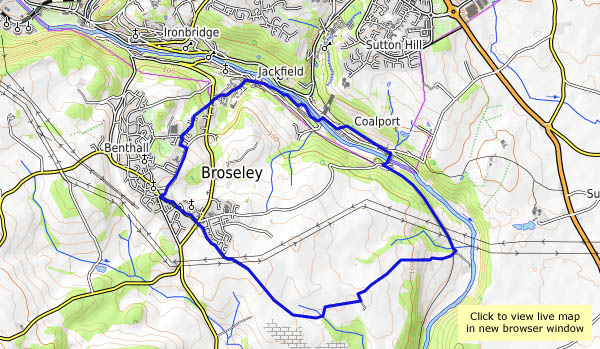
It’s downhill all the way from Broseley to the river; the railway track is more-or-less level. To get to the bus stop in Bridgnorth, we face a long flight of steps, which comes as a shock to the system after about 8 miles of walking. With 45 minutes to kill before the next bus, a pint will be a perfect remedy…

View OS map in Streetmap http://www.streetmap.co.uk/map.srf?X=369185&Y=297306&A=Y&Z=126

Benthall Buttercups

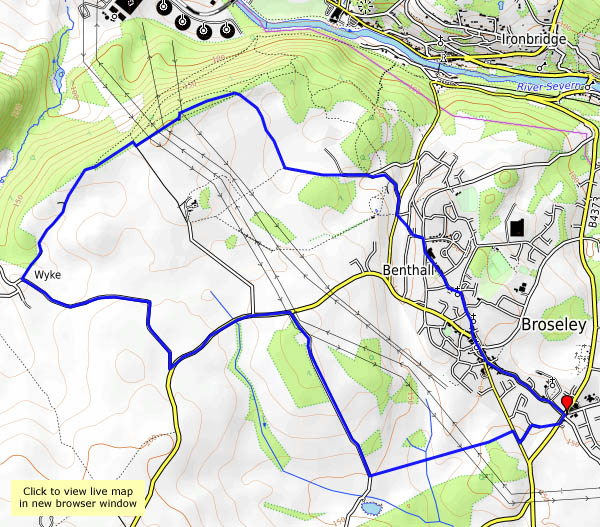
It’s a beautiful afternoon – too good to stay at home, too warm to walk far in the sunshine. If we leave the car at Benthall Hall we can do a circular walk, much of it in the very pleasant woodlands of Benthall Edge and nearby. It’s lovely down in the woods today, as the song goes, but we must leave them to walk back through the fields towards the car – fields full of buttercups, yellow in all directions.

View OS map on Streetmap http://www.streetmap.co.uk/map.srf?X=365735&Y=302716&A=Y&Z=120

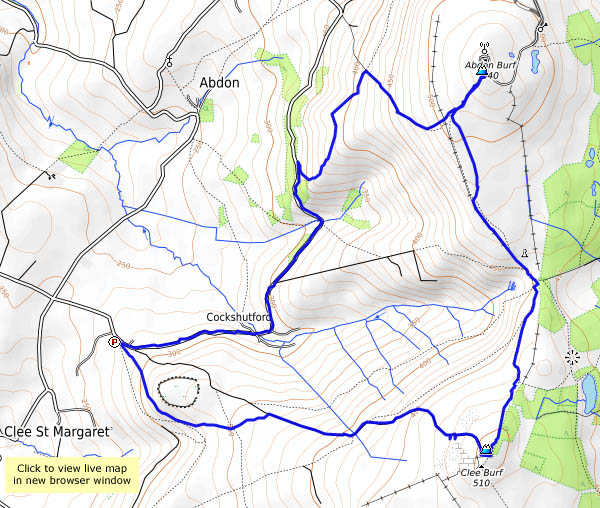
Magpie, Titterstone and Clee

Walking in south Shropshire with a “railway” friend: one who appreciates the interest in the remnants of industry in these very quiet hills. They’ve been extensively quarried for stone – parts are still being worked – and the coal measures were exploited too, many years ago. There are former railway trackbeds, of the standard gauge line which took stone down to Ludlow, and the narrow gauge lines which threaded the workings. Magpie Hill’s stone went by a different means and route – an aerial ropeway took its stone down to Detton Ford, on the long-gone CM&DP. The concrete bases of the pylons are still in place, and there are bits of rail here and there, mostly in use as fence posts and similar. Long-abandoned concrete structures stand here and there, slowly crumbling, like the remains of some lost futuristic city. They can feel rather spooky when the mist comes down, but there’s no such nonsense on a fine sunny June day.

View OS map on Streetmap http://www.streetmap.co.uk/map.srf?X=359845&Y=276831&A=Y&Z=120

Coalport cakewalk

What better reason could there be? The youth hostel at Coalport, beside the china works, is a quiet and sheltered spot for refreshment (with the added entertainment of watching visitors trying to park their cars – yes, we’ll sit outside), perhaps a little over half-way on this enjoyable (and easy…) walk. And once again, after some showery weather, it’s a very pleasant day for it. There’s colour everywhere – the oilseed rape may be past its best, but there’s plenty more yellow in the hedgerows and verges – and purple, and blue, and white to set it off. There’s a cool breeze when we start out, but it’s quite still in the deeper parts of the lane, and the air is heavy with the scent of the May blossom.

The Mynd and XXX

Another ideal afternoon for wandering on Shropshire’s hills. We’ve parked at Bridges (very handy for the Horseshoe Inn, which seems to be called the Bridges now), and we’re heading north-east beside Darnford Brook, to reach the skyline at Betchcott Hill. The last short ascent is by the aptly-named “Golden Valley”, lined with glowing gorse. This is a walk of four parts: part two now begins as we turn through 90 degrees and head south-east along the ridge of the grassy hill, following the ancient Port Way. Part three starts when we reach the heather-clad Long Mynd – another 90 degree turn, still on the Port Way, taking us to the Shooting Box. Now it’s downhill (almost) all the way, with heather giving way to grassland near the derelict ruin that bears the unlikely name of “Priory Cottage”, according to the map. From Coates Farm, a quiet road takes us back down to Bridges, and a most welcome pint of Three Tuns – a perfect pint in a perfect spot on a perfect afternoon – XXX

More on XXX here https://www.threetunsbrewery.co.uk/pages/our-beers

View OS map on Streetmap http://www.streetmap.co.uk/map.srf?X=341105&Y=296796&A=Y&Z=120

Taking flight…

Sunday 24 April 2016: let’s step back just over 12 months: “He’s sent us vouchers for a helicopter trip!”. The facial expression said it all – I think she nearly took flight there and then… With a busy summer ahead and lots of unknowns, we didn’t get round to redeeming them until the autumn. The first booking was cancelled due to the weather – as was the second, and the third, and… (it’s reassuring really). Eventually, we made it, and with plenty of time to get used to the idea, “we” were quite looking forward to the flight. “Is that it? It’s tiny!”. Yes, a very modern-looking (I’m no expert) little four-seater job – driver and three passengers.

We’re flying from Halfpenny Green – “Wolverhampton Airport”, though its WW2 origins are still pretty obvious. We’re strapped in (car-type seat belts) in minutes and away – and despite the clattering of rotor blades while we waited to board, it’s quiet and peaceful (thanks partly to the headphones, I guess) – a very relaxing way to travel over the Shropshire countryside, bobbing and swaying gently in the breeze, with little sense of forward motion. First we’re heading for Bridgnorth, then turning to fly above the Severn, passing Stanley Hall, the fishing lakes at The Boldings and Apley Hall. Soon Broseley is over to our left, and in moments we’re above Ironbridge. As we pass the power station, we begin to turn back, viewing the huge bends upstream in the Severn before buzzing Benthall Hall and skirting Broseley again. Staying west of the river, we’re soon looking down on Bridgnorth, then Chelmarsh reservoir and, crossing the river, Dudmaston Hall. Not far to go now – losing height again to make a gentle landing back at Halfpenny Green. What a great trip! Many, many thanks, T. “When can we go again?” ‘Nuff said!