Walking back…

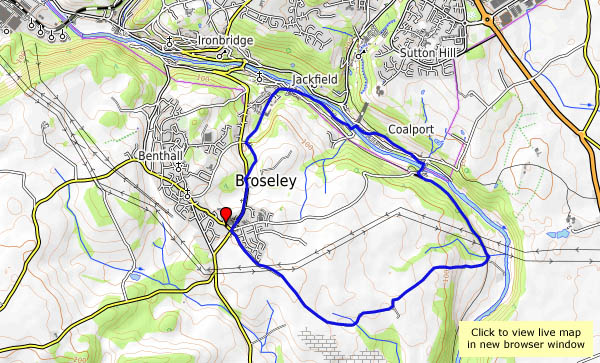
…from Much Wenlock to Broseley, after a ride on the no.18 bus. The spring lambs are out and about, but there’s not much gambolling going on – it’s too cold, despite the warm (but intermittent) sunshine. It’s not very quiet either, especially between Wenlock and Benthall Hall. We passed more people than in our last half-dozen walks – mostly teenage schoolchildren on some kind of organised outing – and a dog near Wyke was noisily expressing its displeasure at being kept in a cage. I think I would too.

View OS map in Streetmap http://www.streetmap.co.uk/map.srf?X=364895&Y=301456&A=Y&Z=120

Wall to wall

That’s what the forecast said about the sunshine – we had to go… Stiperstones in April – warm sunshine, cool air and a pleasant breeze, perfect conditions for a walk on this rocky ridge. We started at the Bog car park – so that we could end at the Bog Centre (tea and cakes again). If we walked to Snailbeach, along the hill-edge paths, we could come back up through the Hollies and follow the ridge. The now-obligatory red kite wheeled over the far hillside, and a little later, a rarer bird, so to speak: a red grouse stalked carefully along just yards from the path. We’ll sometimes hear them up here, gurgling comically and telling us to go back, but this one remained silent. Minutes earlier, we’d noted how quiet it was. He must have heard us…

The Bog Visitor Centre

View OS map on Streetmap http://www.streetmap.co.uk/map.srf?X=337095&Y=299856&A=Y&Z=120

Priors Holt to Black Knoll

The day changed: it was bright and sunny when we left Priors Holt (or “Witchend” to Malcolm Saville “Lone Pine” afficionadoes), but the forecast was right. It was windy too – we’d planned a different route from Black Knoll, but the wind was strong and bitter on the exposed south-eastern flank of the Mynd – much more so than on the ridge path – so we retraced our steps to the forest. A red kite wheeling nearby was never close enough for the camera, and the three deer in the woods, just yards away, were gone in seconds. No photos of them either…

View OS map on Streetmap http://www.streetmap.co.uk/map.srf?X=340535&Y=289336&A=Y&Z=120

Back to the Munslows

A pleasant five-mile stroll in a quiet part of the Wenlock Edge – and once we’re away from the road, it really is quiet. The birds are singing, but that doesn’t count as noise, and the only other sound, as we approach the highest parts, is the gentle rustling of a very light breeze in the trees. It’s clear too – the Black Mountains stand out to the south-west. At home, the grass needs cutting, but it will have to wait…

View OS map on Streetmap http://www.streetmap.co.uk/map.srf?X=351485&Y=287911&A=Y&Z=120

Mary Knoll – 40 years later

We’ve walked many times in the woodlands to the south-west of Ludlow – this walk was probably our first. Today we retraced our steps, visiting Mary Knoll Valley for the first time in 40 years. The valley, with its pleasant but well-hidden little stream, cuts deeply through the land. Near its head, there’s a herd of deer, and beyond Mary Knoll itself, there are woodpeckers hammering away in the trees. Earlier, as we drove towards Ludlow, we’d passed a pair of red kites, wheeling in the warming air. Oddly, this walk seemed shorter than it was in 1976, though the trees have grown, and Ludford weir has been tidied up. How will it all look in 2056? (Will we care?)

Photo note: it was a dull, slightly murky day in 1976, so I used a roll of FP4 (monochrome) film – which I reversal-processed for black-and-white slides. I was rather pleased with the results, though I never tried it again…


View OS map on Streetmap http://www.streetmap.co.uk/map.srf?X=349675&Y=273336&A=Y&Z=120

Mitchell’s Fold and Bromlow Callow

We’re on the western fringe of Shropshire today, in a part of the county where the distant past has some significance. Mitchell’s Fold stone circle is a well-known ancient monument, whose location on this high grassy ridge makes up for a lack of stature – it’s not Stonehenge. Walking on, we arrive at Castle Ring (a pretty straightforward name for a hill fort) – again, not the biggest in these parts, but its situation is dramatic. We take a detour on the way there, to visit the top of Rorrington Hill. No cairn or OS column – the highest point must be found by guesswork. Eventually, we come to Bromlow Callow. I’ve no idea what its history might be, but the round hill topped by a clump of tall trees makes it a distinctive landmark in these parts. The view would be tremendous on a clearer day – it’s hazy again, and we can only just make out the Long Mountain (it may be long, but it’s hardly a mountain) barely five miles away. Our return takes us to the highest point of Stapeley Hill – again, it’s not a mountain, but at least its highest points are marked by rocks and cairns. We could have had better views today, though we did see a hare – he must have been just a few yards away when we startled him. With sunshine and light winds, it’s been another great day out on the hills.

Or view OS map on Streetmap http://www.streetmap.co.uk/map.srf?X=331605&Y=299611&A=Y&Z=120

Watercolour days

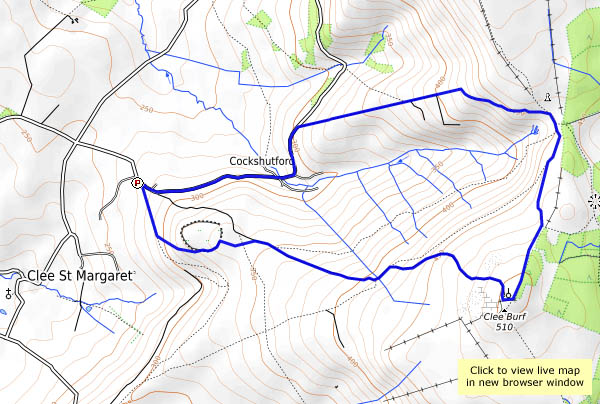
Friday: spring is in the air – and there’s a spring in our steps. It’s not warm, but this is the first day we haven’t needed gloves, scarves, hats etc. With the change in weather has come a haze, shortening our horizons and fading them to shades of watercolour. We’re following a new (for us) route, using a permissive bridleway and gentle gradients to reach Boyne Water, an attractive pool which is larger than one might expect, so near the summit ridge of Brown Clee. Minutes later, we exchange the eastern view – pleasant gentle countryside, for the western view – the indistinct pastel-blue ridges of the border hills. It’s good up here on a day like this, but we can’t stay, and we’re soon threading our way back down between moss- and lichen-clad trees, towards the car and the short journey home.

Or view OS map on Streetmap http://www.streetmap.co.uk/map.srf?X=360140&Y=285876&A=Y&Z=120