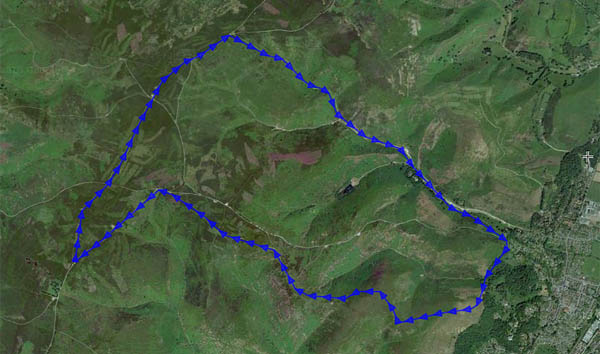
The Packet Stone and Pole Bank

At Pole Bank, I took off my gloves to eat an apple – my fingers were nearly frozen when I’d finished, and it was only a little one. Temperature aside, it felt as though spring could be in the air this afternoon on the Long Mynd. Around Little Stretton, the birds’ singing seemed to confirm my suspicions. Clear air (the Brecon Beacons just visible to the south), bright sunshine and just a very light breeze – perfect! One of those afternoons when it’s too good to come down again…

View OS map on Streetmap http://www.streetmap.co.uk/map.srf?X=342450&Y=292486&A=Y&Z=120

Tautology on the Mynd

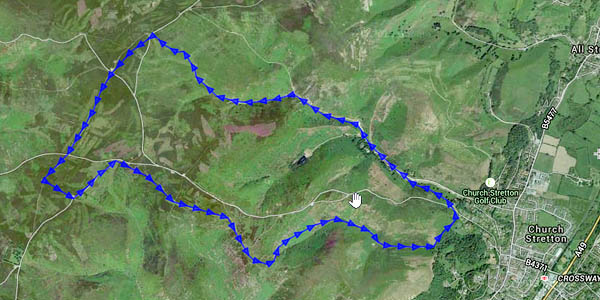
No, nothing to do with the once-popular pets – in fact we kept up a pretty good pace (these new boots must have belonged to Mercury; happily their wings are invisible to mortals). We were walking an 8-mile circuit from the Cardingmill, out via Cwm Dale and Batch Valley – which might roughly translate as “Valley Valley” and “Valley Valley”. Nomenclature notwithstanding, it’s a very pleasant route, which takes us to the Mynd plateau and an easy stroll to the highest point at Pole Bank. The days are getting longer, but so were the shadows as we approached the top, so the photos must end there…

View OS map on Streetmap http://www.streetmap.co.uk/map.srf?X=343855&Y=295086&A=Y&Z=120

Mynd – or mountain?

A dry and bright day – we’re making the most of it before tomorrow’s forecast deluge. The same forecast gave us blue skies all day today – huh! The sun deigned to shine half-way through the walk, from a very low angle, putting some much-needed shape into the landscape. It was chilly, and windy – not a day for hanging around – but very pleasant, perfect for blowing away a few Christmas cobwebs.

In Welsh, the Long Mynd would be Mynydd Hir – Long Mountain – but we’re in Shropshire. About 10 miles to the north-west lies the Long Mountain. It’s in Wales. It’s interesting in the border country…

View OS map on Streetmap http://www.streetmap.co.uk/map.srf?X=342285&Y=295245&A=Y&Z=120

Gogbatch

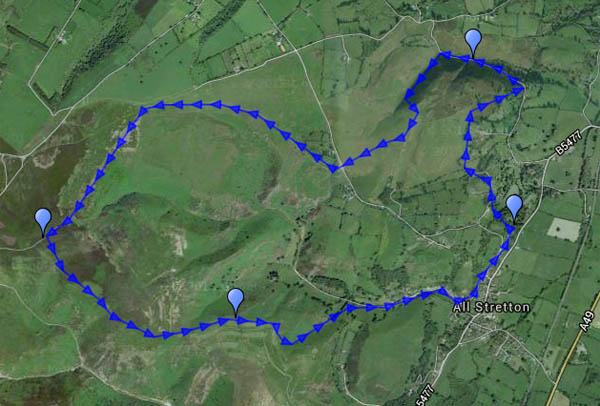
Last gasp of the Long Mynd, before it fades into the fields and pastures of the plain to the north, is Gogbatch. It’s a pleasant – and quiet – spot for a picnic, despite having a (very minor) road running its entire (very short) length. It’s a good spot to begin a walk, too, on this comfortably warm August afternoon. There’s just enough breeze to maintain the comfort as we ascend gradually past Jinlye and Jonathan’s Rock to the main plateau. Our return route skirts the golf course, before descending through deep bracken into the Batch Valley. There’s an inviting but evidently little-used path from All Stretton back towards the slopes of the Mynd. The Himalayan balsam is invading, but brambles and more deep bracken nearly force us to retrace our steps (note to self – bring secateurs next time. And a billhook? And a flame-thrower? Perhaps not).

Map

View OS map on Streetmap http://www.streetmap.co.uk/map.srf?X=345305&Y=296096&A=Y&Z=120

Two sunny afternoons

They’re too good to waste! Bright sunshine, fluffy clouds, not too warm – ideal for wandering.

Wednesday: To Benthall Edge and Hall (tea and cake)

Thursday: Long Mynd. A route we’ve done many times, starting from the Cardingmill valley and ascending via the Lightspout (hoardes of schoolchildren – it’s peak field trip season). Beyond the waterfall it’s quiet – just the sheep and the hill ponies to accompany us to Pole Bank. We return along the ridge to Townbrook Valley, a pleasant path to take us back to the start.

Map

View OS map on Streetmap http://www.streetmap.co.uk/map.srf?X=343005&Y=294546&A=Y&Z=120

Packetstone and Ashes

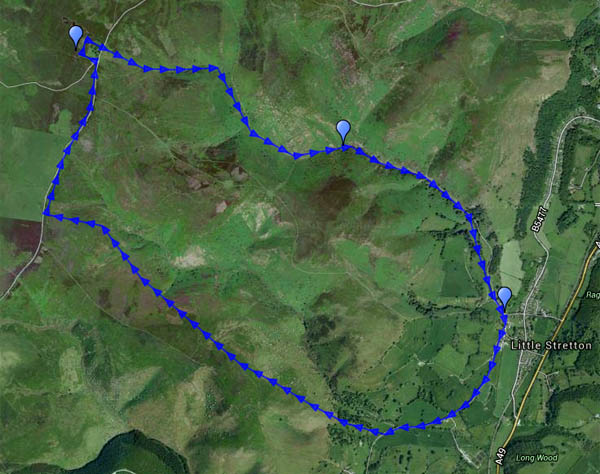
Having made a plan, one should adhere to it… This walk was going to be “Callow Hollow and…”, but when we’d followed the route through the plantation to gain access to Callow Hollow, we looked at the descent, then looked at the steep but inviting ridge ahead – and continued up the hill instead. The good path which we joined on reaching the plateau gradually fizzled out, and we eventually gained the road after struggling through tussocky heather. There is, of course, an excellent track on the southern flank of Packetstone Hill, but I’d forgotten about it…

We had debated leaving jackets in the car – although the air was cold, the sunshine in Little Stretton was comfortably warm. We got this decision right – we were glad of them on top where, when the sun dodged behind the clouds (few and far between) the breeze became a bitter wind. Dropping down into Ashes Hollow, we were out of the wind, and the late afternoon sunshine was very pleasant.

Map

View OS map on Streetmap http://www.streetmap.co.uk/map.srf?X=342505&Y=292436&A=Y&Z=120

Sunspots and Thresholds

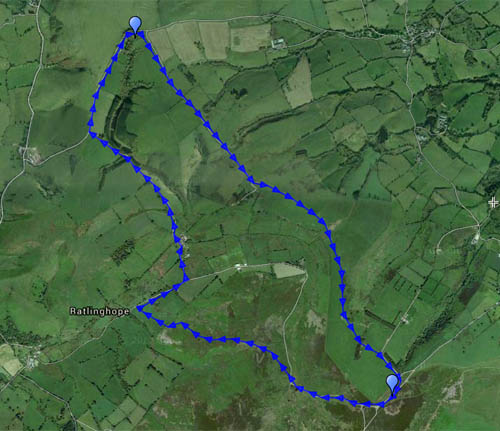
Thresholds is a farm, at the northern end of Betchcott hill, between Picklescott and Ratlinghope (yes, really – this is Shropshire); sunspots are sunspots. The morning’s mist cleared to a blue sky; we chose a route which should make the most of the sunshine. There’s no wind to speak of, it’s a beautiful afternoon to be out on the hills. There’s still some snow too – it’s melting, but there’s plenty of white in the landscape. As we drove to the start of the walk, we could see banks of mist away to the north, with the Wrekin behind. As we turned back towards the car at Thresholds, the view to the north opened up again – in the place of the mist, there was a sea of murk. Before we knew it, the murk had engulfed us – not thick fog, but an eerie mist through which a pale sun was barely visible.

Sunspots: I took a couple of pictures of the aforementioned pale sun with the lens at full zoom; when I studied them 1:1 on the computer screen, I could see darker spots on the sun. First thought: dust spots on the camera sensor. Then I realised they were in the same place on the sun in both pictures, though the sun was in a different part of the picture. A quick check on the web – see http://sohowww.nascom.nasa.gov/data/synoptic/sunspots_earth/sunspots_512_20150208.jpg – confirmed my guess. Sunspots! Haven’t seen sunspots before…

Map

View OS map on Streetmap http://www.streetmap.co.uk/map.srf?X=342310&Y=297956&A=Y&Z=120

January on the Mynd

We’ve done it many times, always with subtle variations. The afternoon was too good to waste – leaving the car in the Carding Mill Valley, we walked up Townbrook Valley onto the ridge and on to Pole Bank. The air was growing cold as we headed back towards Mott’s Road; if we’d done this a month ago, it would have been dark by the time we got back to the car.

Map

View OS map on Streetmap http://www.streetmap.co.uk/map.srf?X=343320&Y=294676&A=Y&Z=120

Another afternoon on the Mynd

Monday: the weather’s too good to stay indoors (and it can’t last) – we’re wandering on the Long Mynd, making the most of what little light there is in late November. The steep hillside path takes us quickly up into the sunshine, and by the time we’re coming back down Mott’s Road, it’s almost gone. Instead of the heavy clouds that shaded us yesterday, there’s lots of wispy cirrus, much of it forming from jet trails. And instead of that biting wind, there’s just a gentle breeze. Perfect!

Map

Or view OS map on Streetmap http://www.streetmap.co.uk/map.srf?X=343240&Y=294746&A=Y&Z=120

Callow Hollow

The Long Mynd’s eastern valleys are several and varied – some are valleys, some (most) are batches. There’s a dale and a gutter too – and a couple of hollows. If we count the side valleys off those main valleys… Perhaps not. I’ve been exploring the Mynd for many years, but until very recently, I had not quite digested one rather odd fact born out by the 1:25,000 map: many (perhaps most) of those side valleys have names – except for Ashes Hollow, whose side valleys are nameless. (I’m sure they’re not, but there are no names on the map).

Ashes Hollow runs down to Little Stretton. Next, joining Ashes at its foot, is Small Batch (aptly named), then there’s Callow Hollow. Ashes Hollow is perhaps the next-best known after Cardingmill (Valley), not least due to the camp site occupying its last few yards. Callow is one of the least known, despite being of comparable scenic value, largely because, until relatively recently, there was no easy access to its foot. We met no-one else on foot throughout the walk (just one cyclist, and a farmer in his pickup). And, like so many of these valleys (batches, hollows etc….), once we’re just a few yards in, there’s nothing man-made in sight, until we reach the plateau and the road.