Back to the Tackeroo

We’re taking advantage of dry and bright weather in the early afternoon – rain is forecast to spread from the west later, so if we head east, we might stay dry.

The “Tackeroo” was the first world war military railway on Cannock Chase. Much of its route can still be traced, especially the long straight cutting as it climbs from Milford towards the plateau. We begin our walk this way, leaving the trackbed at the south-eastern end of the cutting to head for the stepping stones over the Sher brook. Still heading south-east, Heywood Slade leads us to Marquis Drive and the trig point, where we turn towards the brook and up again to the glacial boulder. As we descend to the northern fringes of Brocton, four deer cross our path, some distance away. They haven’t seen us, but they’re not posing for photographs.

The windscreen wipers are on within minutes of leaving for home – excellent timing!

Map of the military railways on Cannock Chase

On Haughmond Hill

A wet morning, but the forecast promised a fine afternoon – somewhere that won’t be too bad underfoot? Haughmond Hill is mostly forested, but the tracks are pleasant, good to walk on, and there are some extensive views. The hill isn’t high, barely topping 500′ (153m, according to the OS) – but there’s little to get in the way of the long view in a 180º panorama from south-east to north-west – the Stretton hills, Stiperstones, Long Mountain, the Breiddens and the Berwyns.

There’s a café back at the car park – we made it with just minutes to spare. The cakes were pretty good too, eaten beneath tall pines.

Here’s a map – haven’t attempted to show the route (can’t see it for all the trees). We followed the blue waymarkers, anticlockwise…

Another Autumn Gala: Toddington

Sena (and Stanhope, and Justine) at Toddington

The season continues: this weekend the Toddington Narrow Gauge Railway held its Autumn Steam Gala. Two residents – Jung “Justine” and Henschel Brigadelok “Sena” were in action, together with visiting Kerr Stuart “Stanhope” from Apedale. There’s action on the standard gauge too – two 2-8-0s, one of which has an interesting history. Visit “Little and Large at Toddington” for more…

Westhope and Diddlebury Common

I’m reliably informed that it’s pronounced “Delbury” (as in the nearby Delbury Hall). This was a very pleasant four-mile wander around Westhope, the most south-westerly “hope” on the Wenlock Edge. The woodlands are increasingly autumnal; the paths through the fields are not always obvious or well-marked (potato fields are not easy to cross). Westhope itself is a quiet hamlet; its college offers craft courses, of which there’s evidence on the wall, and its teas would be splendid, I’m sure, if this was high summer and the rooms were open. The nearby pigs are entertaining…


Chapel Lawn and Caer Caradoc

Most Salopians will know of Caer Caradoc – the hill near Church Stretton with the eponymous hill fort atop its summit. Few will be aware that there is another hill fort bearing the name Caer Caradoc, in the far south-west of the county, less than two miles from the Welsh border near Knighton. Undoubtedly less well known, it is by far the more impressive. High above the delightful hamlet of Chapel Lawn, in the Redlake valley, its earthen ramparts are steep and high. Many years have passed since the Iron Age, but those defences would still be effective today.

It’s a super viewpoint too – those ancient warriors would have had a clear view of potential aggressors long before they arrived – a great place to be on this unseasonably pleasant afternoon. Chapel Lawn is a good starting place – walkers are welcome to park in the village hall car park, according to the village website, and the eggs from the community produce stall (honesty box) look as though they are truly free-range (haven’t tried them yet).

Foxfield’s Autumn Gala

On the bankSeptember has been busy! It’s the turn of the Foxfield Railway this weekend – its Autumn Steam Gala. And what a great day – good weather and lots of noisy steam action on the fearsome gradient from the colliery, for stills and video. A “Rail Diaries” page will appear in a day or so – in the meantime, as ever, here’s a quick preview. (it’s a shame there isn’t something like this going on every weekend, though if there was, I’d be exhausted by Christmas)

Foxfield Railway

Coalport and the jungle

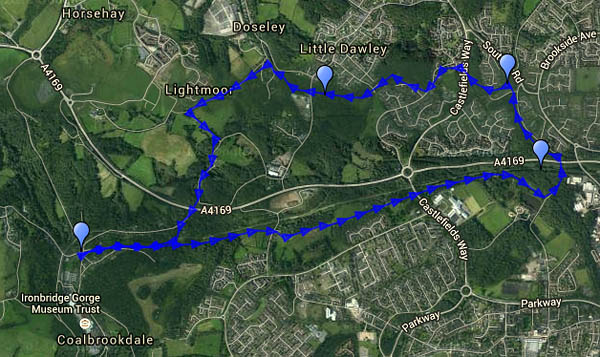
We walked down to the Severn, using paths through the woodland where possible, then along past Craven Dunnills and the site of the land stabilisation work. It’s a mess at present, but no doubt, once the work is complete, the vegetation will soon grow up again. There’s a cup of tea and a cake in the café at Maw’s, before we cross the memorial footbridge and walk beside the canal, then up to the old Coalport railway track to take us to Coalport bridge. Back on the south side, we follow the old Severn Valley railway trackbed.

We’d intended to walk back to Coalport and up the dingle (that’s the route indicated on the map below) but, just a little way before we would leave the railway route, there’s an entry into the woodland to our left, and a sign to the effect that walkers are welcome to wander in the woods. Perhaps we can take a shortcut through to the top of the dingle? The path is clear at first, but gradually fades, until we’re picking our way through dense undergrowth and following nothing more than a sense of direction. An animal started in the woodland below – the size of a large sheep. but it wasn’t a sheep. A muntjac? Gone before we had a clear view.

We found our way out, further down the dingle than I’d expected. An interesting exploration; not a short cut…

Route