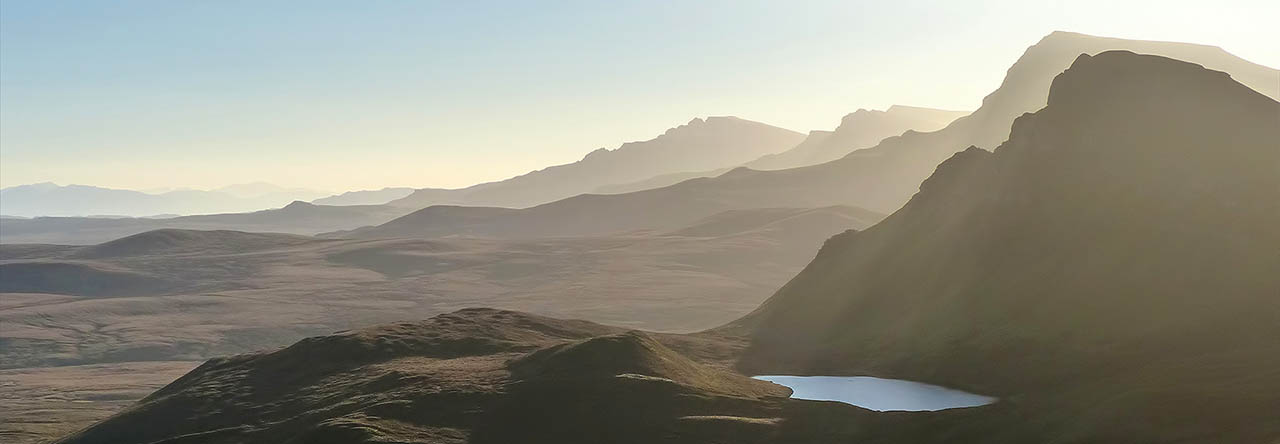
A gentle stroll from the NT car park in Cardingmill valley – up to and around the reservoir, then to the Lightspout waterfall by the high level path. Iron pipes, visible in places along the route, suggest that the path dates from the construction of the reservoir, the pipes feeding extra water from the Lightspout Hollow. We climb up beside the waterfall (there are steps…) and onto the moorland beyond. Descending Mott’s Road brings us to the pavilion in nice time for tea and cake…
Category: Photography
Just photos – no particular theme
A Peacock at Chasewater
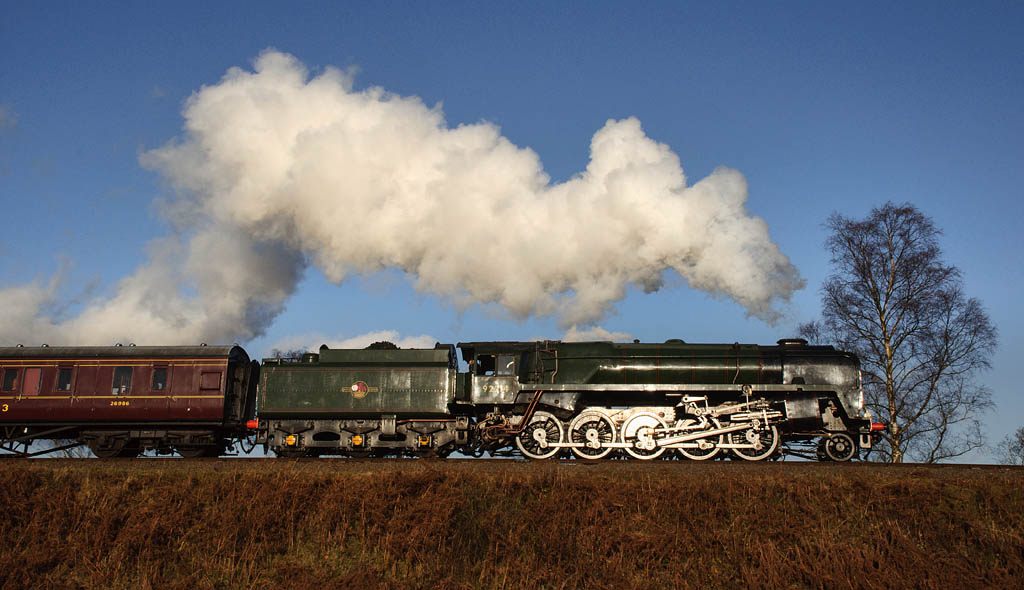
There are moorhens in the lake, and giant dragonflies flitting about in the purple heather on the heath. There are deer grazing peacefully no great distance from the main path, just yards from the railway. And on the railway, today, is a Peacock – a Beyer Peacock, built in 1879. It makes Colin McAndrew, 103 years old, look modern. There will be more photos and video, in due course, on the “Rail Diaries” pages.
Middlehope
Three dales accompany the Wenlock Edge – Corve Dale, to the south-east, is named after its river; Ape Dale to the north-west has its brooks, but is more a natural gap between the edge and other hills than a valley as such. Hope Dale lies in the middle, between the twin escarpments of the edge. In Hope Dale, towards Wenlock, there’s the hamlet of Easthope. Westhope is further to the (south) west, oddly enough. And in the middle (of the middle) is Middlehope. It’s not very big, but surely it’s better to travel and to live in (Middle?) hope? (Enough!)
This was a pleasant walk on a pleasant afternoon. The farmers are getting their crops in, making the most of the dry weather. The colours are beginning to look autumnal, there are blackberries and fungi everywhere (and one sweet, juicy damson). It’s almost a shame to arrive back at the car, to travel hopefully towards home.
More Much Wenlock Wandering
Barely four miles, this was a pleasant amble through less frequented country, where signs of the coming autumn gather apace. There are elderberries, sloes, hips, haws – and blackberries by the ton. Not physically in the way, their presence nevertheless delayed our progress, as stained fingers will testify.
Blackpool to High Vinnals
– a walk in the forest
The Blackpool (or Black Pool, interchangeable if the waymarkers are to be believed) in question is a mile or two south of Ludlow, just past the village of Overton on the Richard’s Castle road. We’ve walked to High Vinnals before, always from the other side (see High Vinnals and the pop-up tea rooms). Time for a change!
It’s an easy ascent, at first through extensive forest, though the paths are pleasant enough. The landscape opens up a little at Climbing Jack Common, and the views from High Vinnals would be tremendous, if it wasn’t for all the trees… There are gaps to the west, and to the east, the trees are still small. A little west of south, looking along the ridge, we can see the Black Mountains, and further west, Pen-y-Fan is just visible through the haze, some 40-odd miles away.
We’re heading back towards the car now, mostly along forestry tracks, with the odd stretch of footpath cutting through the necks of some of the loops. There’s just a little blue butterfly flitting about in the heather, and a friendly frog, to delay our return.
A welcome return to steam
There have been some remarkable restorations and rebuilds in recent years (some wonderful new builds too). Surely the most unlikely rebuild to date is this one – Hudswell Clarke 1238 of 1916 fell into a river in Ghana, during a storm in 1948. It lay there, abandoned and forgotten, for 48 years. Today, at the Statfold Barn Railway, it made its formal return to active service for its owners, the Moseley Railway Trust. For more on today’s events, visit “1238 – Welcome Back” on Geoff’s Rail Diaries, and for more details of the project, visit this page on the Moseley Railway Trust’s Fleet List.
Moseley Railway Trust
Apedale Valley Railway
Statfold Barn Railway
Down the coast – Borth to Aber
Aberystwyth was always “Aber” on the railway – as a chalked destination on a parcels van perhaps. We’d be travelling by rail today, for a leisurely stroll along the cliff-top path from Borth to the university town.
The rain that started minutes after our arrival in Borth accompanied us to the top of the headland; a little way beyond it eased, and we were soon able to pack away the waterproofs and enjoy the coastal scenery. The cliffs are not high, but there is plenty of interest along the route, not least in the stripy strata clearly visible in the rocks.
The shingle spit at Wallog, “Sarn Gynfelyn”, is one of several similar features of the coast. Of man-made appearance, they are the stuff of myth and legend – ancient ways to submerged kingdoms.
Clarach Bay is full of caravans and chalets. It’s not the prettiest part of the walk, and we pass through quickly – but a little way beyond, back on the cliff path, there’s a picnic bench. It provides a quiet spot for a break and a late lunch before we arrive at Aber, to walk along the promenade and enjoy a well-earned ice-cream (“Mario’s” – excellent!)
“Aber” is perhaps a touch ambiguous, and appropriately so. The full name means “mouth of the Ystwyth” – but that river makes a rather inconspicuous approach to the town, sneaking into the Rheidol just yards from the open sea. It’s the latter that is more obvious, providing the harbour for numerous pleasure craft – and, as we waited on the station platform, a Vale of Rheidol train steamed gently into the former Carmarthen line platforms. Aberrheidol perhaps? If nothing else, it would be easier to spell for us poor pob sais.
Harvest time on Wenlock Edge
It’s almost that time of year, when the hedgerows are full of blackberries, and assorted toadstools begin to appear. The farmers are busy too, making the most of a (mostly) dry day. We did this Wenlock Edge walk earlier in the year – clockwise. The views are subtly different in the opposite direction.
The Brigg
Flamborough Head is an obvious feature of the east coast map; just a few miles further north is a lesser promontory. Flamborough’s cliffs are white chalk; Filey’s Brigg is mud… The popular walk from Filey to the Brigg is an easy stroll, on this occasion after a false start – a passing shower caused a diversion to the café…
Nunnington
It’s a National Trust house near Hovingham in Yorkshire – perhaps five or six miles north of the much-better known Castle Howard. Among other things (peacocks, exhibitions etc) it’s noted for a collection of “miniature rooms” on display.