The sun came out after lunch, but the day remained hazy. We’re walking through quiet back-roads, woodland and farm lanes, to Benthall Hall. It’s far enough to feel we’ve earned our tea and cakes – and far enough home again to walk them off…


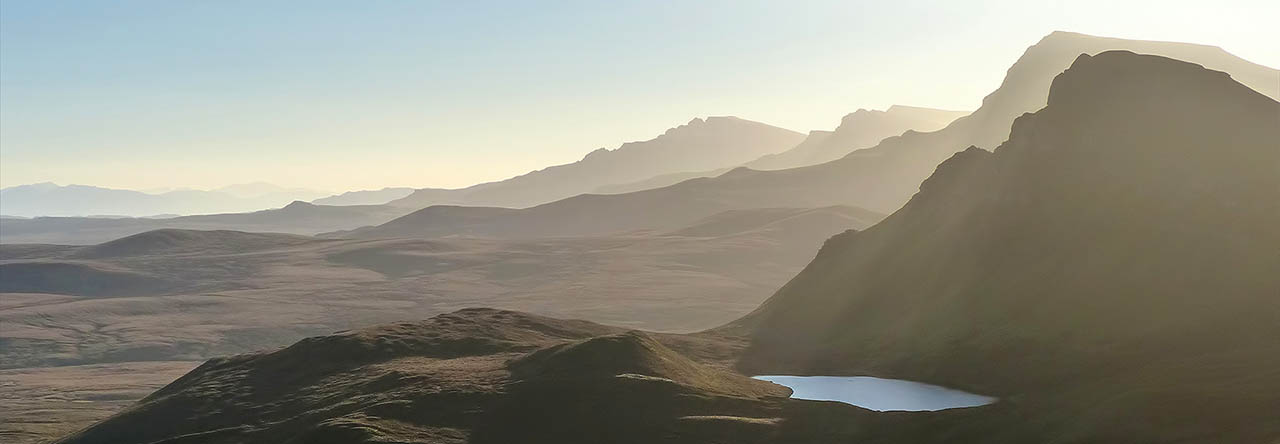
Just photos – no particular theme
The sun came out after lunch, but the day remained hazy. We’re walking through quiet back-roads, woodland and farm lanes, to Benthall Hall. It’s far enough to feel we’ve earned our tea and cakes – and far enough home again to walk them off…
It’s grey and damp today – but Friday and Saturday afternoons were positively springlike. There are few signs of spring, but the air is warmer, the breeze less biting. Friday’s wander was around Coalbrookdale, up and down through the woodlands. Yesterday was Wenlock’s turn, heading through the town, up past the windmill and along the edge.


Thursday: an interesting little outing, taking advantage of London Midland’s “Great Escape” offer within a fairly limited time scale. There was time to get from Lime Street station to the Pierhead, visit the museum, have a bite of lunch, and wander beside the Mersey. The grey skies were clearing rapidly, but we needed to head for home.
More photos (mostly rail-related) on Geoff’s Rail Diaries – visit http://geoffspages.co.uk/raildiary/greatescape.htm to see Lion and the Liverpool Overhead Railway…


It’s been cold and showery recently, but today the temperature made double figures, and the Met Office reckoned it wouldn’t rain before four o’clock. We’d better get out and stretch our legs. Considering that the walk began at Bedlam (the old furnaces beside the Severn), it was quiet in south Telford. We crossed the hill west of Woodside and descended (a little) to the coke hearth, before heading up to Sunniside, returning to the dale past the assorted livestock at the farm – donkeys, llamas, ostriches and geese (and possibly more). We’re heading for the tea room beside the old railway station (excellent cakes – worth hurrying to get there before they close at 3pm). Suitably refreshed, we follow the riverbank back to the car.


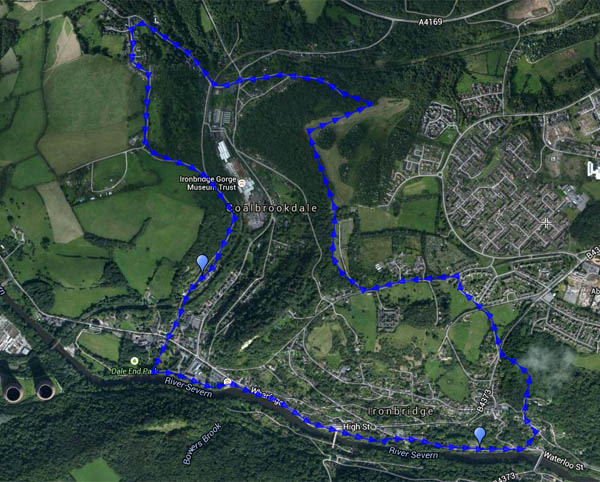
View OS map on Streetmap http://www.streetmap.co.uk/map.srf?X=367415&Y=304216&A=Y&Z=120
“We need to go and see the snowdrops at Attingham”. Yes, I suppose we do, and it looks like being rainy tomorrow and Friday. They are worth seeing, and there will perhaps be tea and cake afterwards. The snowdrop woods are busy – it’s half-term, and there are lots of kids-and-grandparents out today. They’re not really interested in the snowdrops, but that familiar shrill chatter is evidence that they are enjoying their outing (I’m referring to the kids, of course). We continue beyond the snowdrop woods to follow the park perimeter path, and it’s much quieter, perhaps because there’s a crocodile in the swamp. A gap in the trees reveals, perhaps 1km distant, a Roman villa. Is reality on the blink again?


It’s dry and bright, a good afternoon for exploring. It would have been sunnier too, if we’d not been tied up earlier in the day. There are three stretches of road walking en route – the first, the Wenlock to Broseley road, is fairly busy, but there’s ample verge to hop onto when needs must, and it’s downhill… The other roads are very quiet, and quieter still, respectively. And away from the lanes, there’s just the birds, twittering and rustling in the undergrowth. It may be half-term, but there’s no-one else about.


 View OS map on Streetmap http://www.streetmap.co.uk/map.srf?X=365975&Y=298916&A=Y&Z=120
The views wouldn’t be great today. It was very hazy, and there was little chance of sunshine. A walk in woodland might be good – how about Wenlock Edge? There’s a little NT car park where the Hughley road leaves the Wenlock – Stretton road. We could walk along the edge path above the quarries, then back along the track through the woods, a little lower down. We could walk, that is, where the path was fit for walking. No farmers’ tractors this time, just the popularity of the path to blame for the mud, in places barely passable. There may not have been any distant views – a clearing in the trees provides a viewpoint for the Wrekin, way beyond the limit of visibility this afternoon – but it was pleasantly atmospheric, and was it a touch warmer than recently?


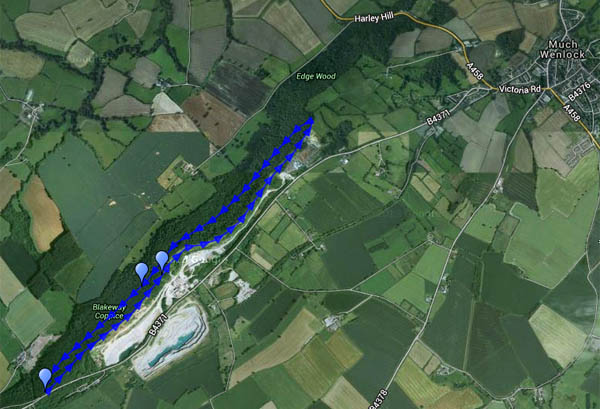 View OS map on Streetmap http://www.streetmap.co.uk/map.srf?X=359285&Y=298596&A=Y&Z=120
Thresholds is a farm, at the northern end of Betchcott hill, between Picklescott and Ratlinghope (yes, really – this is Shropshire); sunspots are sunspots. The morning’s mist cleared to a blue sky; we chose a route which should make the most of the sunshine. There’s no wind to speak of, it’s a beautiful afternoon to be out on the hills. There’s still some snow too – it’s melting, but there’s plenty of white in the landscape. As we drove to the start of the walk, we could see banks of mist away to the north, with the Wrekin behind. As we turned back towards the car at Thresholds, the view to the north opened up again – in the place of the mist, there was a sea of murk. Before we knew it, the murk had engulfed us – not thick fog, but an eerie mist through which a pale sun was barely visible.
Sunspots: I took a couple of pictures of the aforementioned pale sun with the lens at full zoom; when I studied them 1:1 on the computer screen, I could see darker spots on the sun. First thought: dust spots on the camera sensor. Then I realised they were in the same place on the sun in both pictures, though the sun was in a different part of the picture. A quick check on the web – see http://sohowww.nascom.nasa.gov/data/synoptic/sunspots_earth/sunspots_512_20150208.jpg – confirmed my guess. Sunspots! Haven’t seen sunspots before…


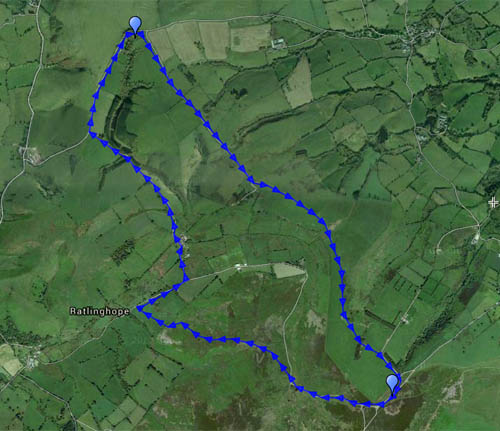
View OS map on Streetmap http://www.streetmap.co.uk/map.srf?X=342310&Y=297956&A=Y&Z=120
We’re in Wales today – lunch at the Cain Valley Hotel, Llanfyllin, followed by a walk in the attractive hills to the east, just across the river Cain. There is a river Abel here too – it joins the Cain at Llanfyllin. It looks little more than a brook on the map, but it makes a good story… Maintaining the biblical theme for just a little longer – we’re walking to Jericho Hill! If the weather had been different we might have stood atop its grassy summit – but we’d have felt the full force of the bitter northerly wind, so we stayed on the path in the hollow. Away from the wind, it was very pleasant in the warm sunshine, which lit the landscape like a floodlight, really bringing out the colour.


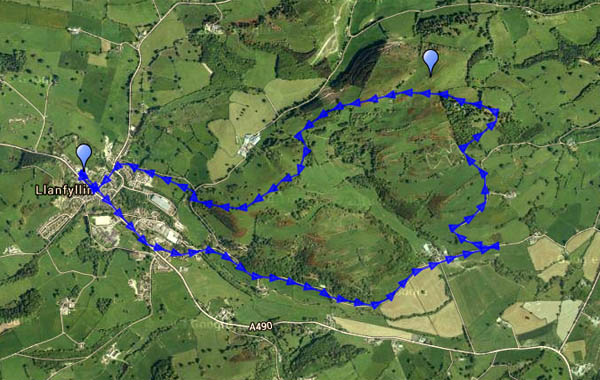
View OS map on Streetmap http://www.streetmap.co.uk/map.srf?X=316004&Y=319473&A=Y&Z=120&ax=367365&ay=301641
It’s not a very high peak, but snow on top made the Wrekin look most inviting. I accepted! It’s cold today – lower down, on the northern slopes, the mud on the path was frozen hard. Higher up, the snow had been well trodden and polished, and the path was treacherous. The antics of descending walkers persuaded me to continue over the top and down through the trees towards Little Hill, to return through the woodland. The sun, which had sneaked behind a patch of cloud, came back out and shone brightly again once I was well into the forest. There’s no snow down here, and the air has been warmed a little – there’s serious mud…


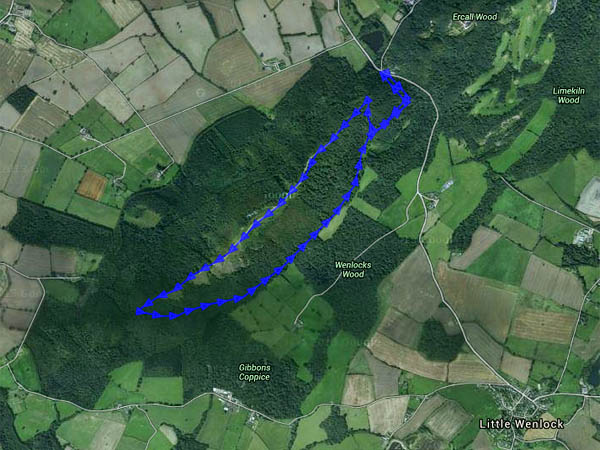 View OS map on Streetmap http://www.streetmap.co.uk/map.srf?X=362970&Y=308206&A=Y&Z=120

