…around some of the local footpaths – a somewhat indirect route to the greengrocer and back…
Author: geoffspages
Walking from Wenlock to Broseley
Tea and cake at Benthall Hall…
We’ve done it before, but last time, the Hall was only open at weekends. Now, it’s open (March to October – closed in the winter) on Tuesdays and Wednesdays too. There’s a tea room, with some tables and seats outside – and it’s just nicely half-way on this walk – perfect!
There are only four buses each day, but the Arriva no. 88 service is ideal for this one (and there’s entertainment value in the negotiation of some of Broseley’s narrower streets, where “anywhere” is the rule for car parking).
There are several possible routes from Benthall Hall to Broseley; most involve field paths and tracks before walking through the streets. On this occasion, we walked down surfaced lanes, to enter Broseley by the “Fiery Fields”.
NOTE for tea drinkers: the tea room is inside the hall, which would require payment of an admission charge; the outside area is not accessible though the hall, but whether one should pay, I’m not sure – we’re members anyway. The Hall is well worth a visit – but muddy feet (and ours were) would not be appreciated…
Bus timetable | Benthall Hall NT
A steamy weekend in Staffordshire
No shortage of steam railways in the county of Stafford! For lots more pictures from Statfold (plus a video of a ride down the line), and a selection (with video) from Chasewater, visit Starting with Statfold and Gervase on Geoff’s Rail Diaries
New toys and visitors
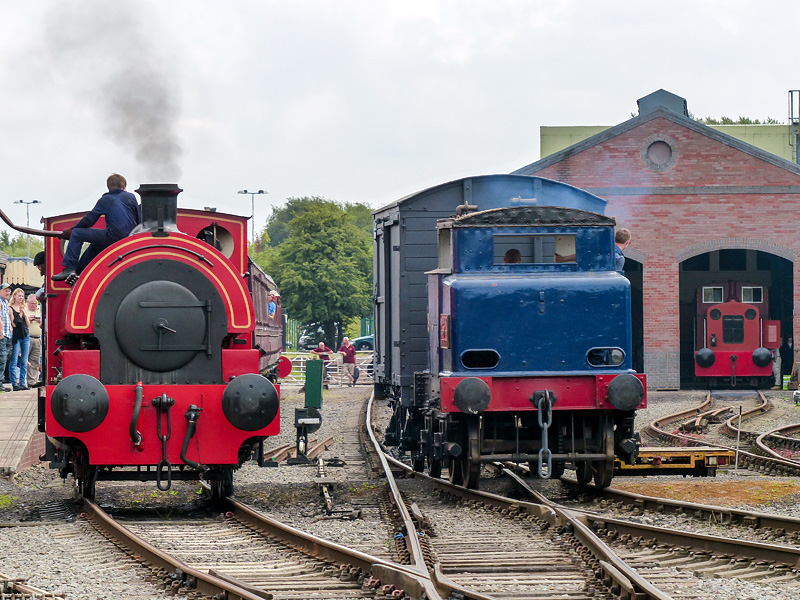
Statfold and Chasewater: a great way to start the season. This year’s first open day at Staffordshire’s narrow gauge heaven was yesterday, 29th March; it was also the weekend of the Chasewater Industrial Gala
What will be new at Statfold (there’s always something)? Mr Lee has been busy with the track – there’s a new loop on the 2′ gauge line at Oak Tree, doubling its capacity, and it now connects to the balloon loop at the far end, so that trains on both lines can run the full length of the layout, round the loop and back along their respective lines. And there’s a new loco, in the splendid shape of Hudswell Clarke 972 of 1912, an 0-6-0 tender engine.
They’ve been busy with the layout at Chasewater too, tidying up the track at the entrance to Brownhills West. Unfortunately the work wasn’t completed in time – no “bay to bay” trains for Colin McAndrew. But he’s got a new companion for the weekend, in the (unusual) shape of visitor Gervase. Gervase is a Sentinel – an early one, dating from 1928, a conversion of a 1900 Manning Wardle, with side rods rather than the chain drive of later machines. We’d better go and have a look – perhaps Sunday’s weather will be good too? It was…
“Rail Diaries” pages will appear in due course. In the meantime, the above tasters will have to do…
Callow Hollow
The Long Mynd’s eastern valleys are several and varied – some are valleys, some (most) are batches. There’s a dale and a gutter too – and a couple of hollows. If we count the side valleys off those main valleys… Perhaps not. I’ve been exploring the Mynd for many years, but until very recently, I had not quite digested one rather odd fact born out by the 1:25,000 map: many (perhaps most) of those side valleys have names – except for Ashes Hollow, whose side valleys are nameless. (I’m sure they’re not, but there are no names on the map).
Ashes Hollow runs down to Little Stretton. Next, joining Ashes at its foot, is Small Batch (aptly named), then there’s Callow Hollow. Ashes Hollow is perhaps the next-best known after Cardingmill (Valley), not least due to the camp site occupying its last few yards. Callow is one of the least known, despite being of comparable scenic value, largely because, until relatively recently, there was no easy access to its foot. We met no-one else on foot throughout the walk (just one cyclist, and a farmer in his pickup). And, like so many of these valleys (batches, hollows etc….), once we’re just a few yards in, there’s nothing man-made in sight, until we reach the plateau and the road.
Croome revisited
We’ve been before – must try to avoid taking the same pictures… Not easy. It’s described as a landscape park – we’d better explore it. The house is worth exploring too, though not all of it is accessible yet – a long term project for the National Trust.
Beacon Hill: peaty pools
There’s a real sense of wilderness on these border hills. Shropshire lies on the opposite bank of the Teme, but Beacon Hill could easily be somewhere much more remote. It could have been quite tricky too, if Shropshire’s fog hadn’t given way to a cloudless sky as we headed west into Powys.
The walk would have been a very wet one a month ago – there’s plenty of evidence of February’s dyke-filling downpours, where animals have churned the ground in some of the wetter places. But mostly it’s really good underfoot – springy turf and heather moor, with delightful peaty pools reflecting the sky’s deep blue. It’s quiet too – apart from one or two vehicles on the lane up from Beguildy, the only sounds are from the sheep and the birds. And yes – this is red kite country, though they’re never quite close enough for the camera.
Bring me sunshine
Two bright, sunny afternoons – too good to waste…
Monday: a walk from Linley to Bridgnorth. I had a lift to the starting point, for a walk which should be well-timed for a lift home again. Down in the valley, out of the wind, I began to wonder if I should have left my jacket behind. The old railway track would provide a reasonable surface if the river-bank path was too sticky – in the event, it wasn’t bad at all.
Tuesday: A walk to Benthall Hall – an old favourite. The tea-room at the hall was a bonus – hadn’t realised it was open mid-week, so early in the season…
Border Castles
Goodrich, the White Castle, Grosmont – three impressive ruins with similarities and differences. Goodrich is in England, beside the Wye near Ross, in the care of English Heritage. There’s lots to see and explore here – spiralling ways up to the heights, dark dungeons and passageways. A walk around the dry moat reveals the rocky foundations.
Further west, in Wales, are the “Three Castles”, from 1201 the property of one Hubert de Burgh. We’ve been to Skenfrith before – let’s look at the White Castle. It really was white once, apparently. Its deep moat is still water-filled, and the ruins are extensive, but there’s only the one tower which can be climbed for a fine (but today hazy) view to the west, where the Skirrid – “Ysgyryd Fawr” – and the Black Mountains are prominent.
Grosmont Castle, third of the “Three Castles” would be on our way home, and there’s still plenty of time. Once again, there’s an entrance across a bridge (which originally would have been a drawbridge), and there’s one way up onto the walls for a good overall view. That chimney is amazing!
White Castle and Grosmont Castle CADW