We would have spent longer, and walked a little further, on the Hope Bowdler hills – at least as far at the Battlestones. But as we took in the view from the ridge, a shower was approaching from the south-west, immediately downwind. We didn’t hang around – and sure enough, we needed the wipers briefly as we drove away. In the event, it was only a little drizzle in the wind – we perhaps wouldn’t have been soaked, but it had looked rather ominous…
Author: geoffspages
Walled garden
We’re wandering around Attingham this afternoon – the walled garden provided colour, the rest of the estate just shades of green.
Edinburgh Trams
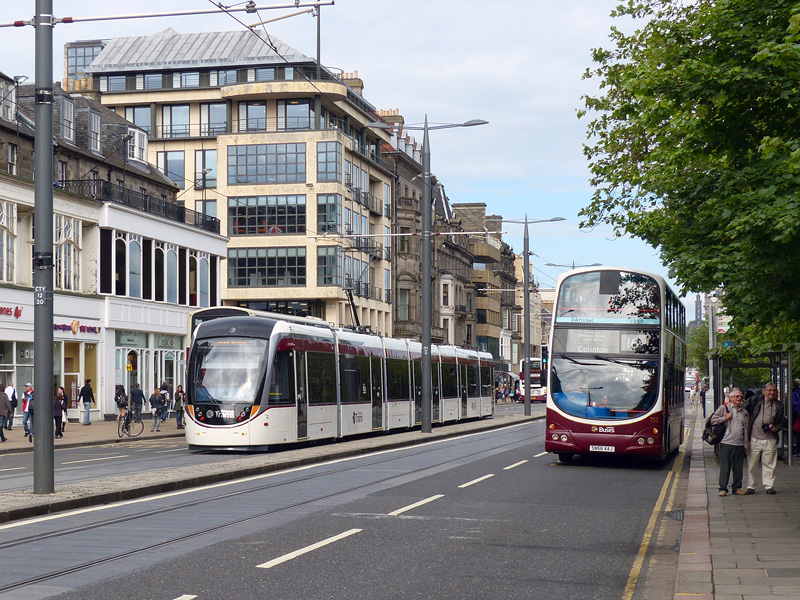
We’ve left Skye – we will be stopping in Edinburgh on the way back. We’ll have to have a look at the new trams… We did!
Visit “They’re back!” on Geoff’s Rail Diaries for more on this splendid new modern tramway
An Àird – dodging the showers
We drove through a heavy shower (it was supposed to be “mostly dry”) on the way there, had to don the waterproofs briefly while we were out on the headland, and drove into another heavy shower as we left. But between the showers, it was good to be out on An Àird, the wing-like peninsular at The Braes, looking across to Raasay. Last year I climbed Ben Tianavaig, the striking peak immediately to the north. I wouldn’t have wished to be there today…
Sìthean a’ Bhealaich Chumhaing
North of Portree there’s a ridge – a line of hills frequently seen in photographs but, I suspect, infrequently visited. The photographs in question are of the Old Man of Storr, with the Storr Lochs and the hills in question behind. The highest point, Sìthean a’ Bhealaich Chumhaing, is just 1286′ above sea level – but that sea is less than half-a-mile from the summit – it’s a splendid airy viewpoint which makes this scenic walk well worthwhile.
I’d be doing this one on my own (just as well…). The household authorities were going shopping in Portree – if I left my car at the north end of the Storr Lochs, I’d have a lift to the start. I’d rather have done the walk in the opposite direction, but that wasn’t going to be quite so easy to organise. Having done the walk, I realise it would be much better walked north to south – route-finding would have been easier (there are a couple of moderately tricky spots going south-north, where it’s important to find the right places to descend from lines of crags). It would have involved less ascent too!
I set out from Portree along the very pleasant path to the Black Rock, continuing by the curiously named “Bile” (a raised beach, apparently) to the start of the ridge proper. There is no obvious path over squelchy moorland which must be crossed before reaching the grassy sheep-cropped ridge, where no path is needed – it’s excellent walking. The main peak comes first, followed by two lesser tops, Creag Ulatota and Fiurnean. The last stretch back to the power station road is a long slog across a pathless sodden moor of tussocky grass, making for slow and hard going, and damp feet. Only once did I see a bootprint. Back at the car, there’s a sign – the Scottish Rights of Way and Access Society proclaims a footpath to Portree, 6.5 miles. Wishful thinking! If there was a path, it would be a truly excellent walk. And it may be 6.5 miles as the crow flies – but I reckon I walked nearer 8…
Quiraing – the other way
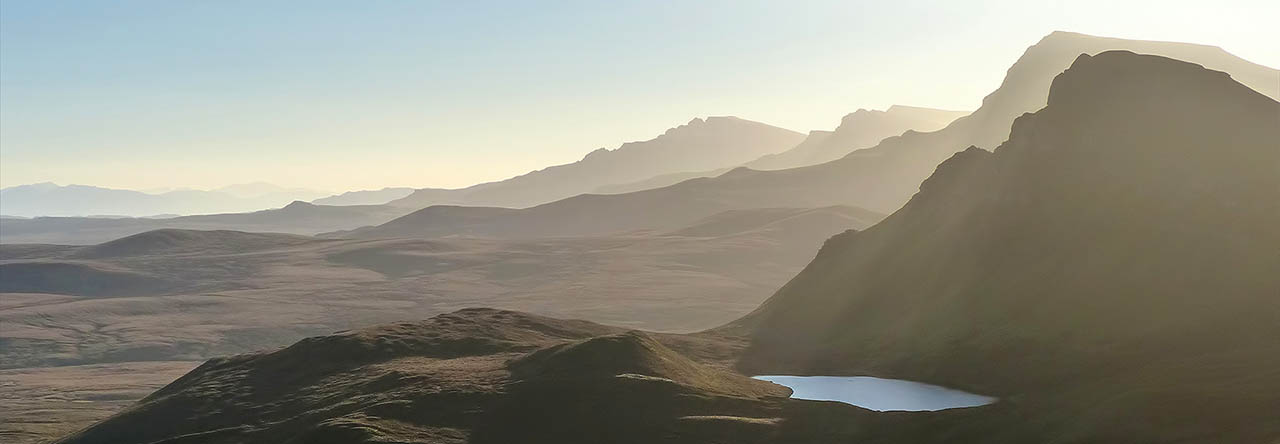
The minor road between Uig and Staffin is very popular with visitors to Skye – the views from the top of the pass are some of the best known in the UK, and the road itself as it winds down the eastern side has featured in countless car advertisements. Consequently, a substantial car park has been made for (perhaps that should read “made by”) those visitors. Many will be content to take in and photograph the views, while others will walk the mile or so to the Quiraing, along one of the country’s finest footpaths. It can be very hard, in the season, to find a parking space, and the path will be busy. There is an alternative…
The aforementioned path actually passes the Quiraing (to enter this astonishing rocky stronghold requires a fairly exposed scramble up a steep loose slope before threading between the tall pinnacles). It continues to a further area of spectacular rock formations – “Fingal’s Pinnacles” – before descending past Lochs Hasco and Langaig to arrive at the main road around the north of the island near Flodigarry. From the main road to the foot of the Quiraing is a little under 2 miles, and involves a steady ascent (about 800′). And it’s not obvious where the path goes. Consequently, this well-made way is quiet.
We wouldn’t be entering the Quiraing itself today (been there/done that several times) – if I could have got my companion up there, I’d never have got her down again. The path itself is a tremendous way of spending an afternoon without that kind of excitement.
The coral beach
It’s one of the most popular short walks on Skye – to a beach of white coral-like material (not true coral but calcified algae, it would appear – does it matter?), eye-catching on any day and brilliant in sunshine. We joined the throng for the mile or so to the coral (it’s the second white beach – there’s a very small imitation part-way which could fool the uninformed), admiring once again the floral variety beside the path and on the rocks. As well as being peak orchid season, there are also great clumps of thrift catching the breeze. It’s very pleasant despite the crowds (there must have been a dozen or more…), and beyond the beach, a path threads the shore to the end of the promontory, a much quieter place from which to gaze on the view to Isay and the outer isles.
A Staffin afternoon
An afternoon which began with mist on the hills, clearing to bright warm sunshine later. There’s a long-established path at Staffin, running from the Columba 1400 car park over the hill to the sea. Descending towards the shore, the age of the path is evident in the well-laid stone blocks forming the surface. It leads to the slipway; our route deviates across slightly marshy ground (pick the way fairly carefully and feet will remain dry) to the saltings and, beyond, some comfortable rocks – a great spot for watching the waves. It’s a scenic route too – super views back to the Trotternish hills as we ascend, with the sea and the mainland ahead once we’ve topped the ridge. As ever at this time of year on Skye, orchids and other wild flowers abound.
Return to Rubha na h-Aiseig
We’ve been here before – it’s a wonderfully quiet walk through some superb coastal scenery to what is not quite the most northerly tip of Skye (the northernmost point, by about 200 yards, is Rubha Hunish, a mile or two to the west). There’s space for a few cars at Port Gobhlaig, and a way across grass to low cliffs above rocky inlets, an arch and a stack, home to numerous seabirds. An old way then descends to the rocky shore, backed by sheep-grazed grassland. It was busy today – we saw (briefly) two other walkers and (even more briefly) an angler. About a mile offshore is the uninhabited Eilean Trodday. In the distance are the hills of Lewis. In the sea, there’s a small yacht (motoring – there’s barely a breeze), a distant tanker, and a fishing boat which struggles against the strong tidal flow. It’s a great place – must return again