November on Clee Hill

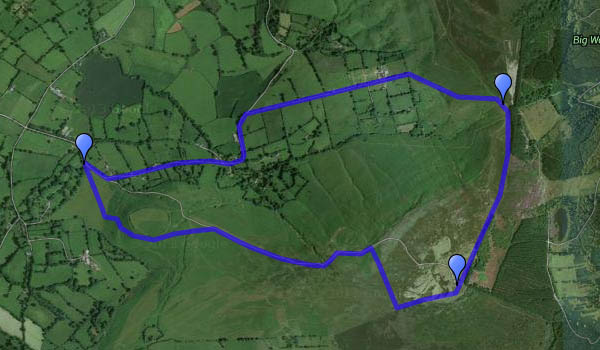
One of those rare afternoons when the sun shines from an almost-cloudless blue sky. It’s cold, and there’s a chilly breeze on top, but it’s a great day to be out on the Shropshire hills.

I’d include a map of the route, but Google have introduced “new My Maps. Better tools for mapping”. ’nuff said.
9 Nov: I’ve been trying Scribblemaps – see below

Map

Or view OS map on Streetmap http://www.streetmap.co.uk/map.srf?X=358500&Y=284901&A=Y&Z=120&ax=358625&ay=284851


The Roaches and Lud’s Church

The Roaches lie just a few miles north of Leek, in Staffordshire. The name derives, supposedly, from the French les roches – the rocks. It’s a most appropriate name too – there are rocks in profusion. The gritstone outcrops along the ridge are spectacular – a great subject for the camera on a day like this, with bright sunshine and low lighting angles.

Not far from the Roaches is another gritstone feature – this time, a deep rocky chasm perhaps 100 yards in length, “Lud’s Church”. Formed, it is thought, some time after the last ice age, a slippage towards the valley has created this remarkable feature. It’s well hidden in the pleasant (if somewhat muddy) woodland, though well signposted – the footpath runs along its length.

The walk back to the car ought to be an anti-climax, but it’s not – the ridge walk back to the road is airy, with excellent views. The afternoon has worn on – the light is distinctly golden for the last stretch, the very quiet road beneath the Roaches taking us back to the car.
 

Moseley Old Hall

It’s a National Trust property, tucked neatly between the M54 and the northern edge of Wolverhampton. It started life as a half-timbered structure – and remains so, though the original building was encased in brick when the hall was “modernised”, in the days before Victoria became queen. Its fame lies with an earlier monarch – King Charles hid there, in one of its priest holes. Whatever its history, it’s an interesting place to explore on a changeable Sunday afternoon.

Moseley Old Hall NT

Grinshill

It’s no mountain – just 192 metres (630 ft) above sea level at the summit – but it’s a great viewpoint for the real hills of Shropshire and the borders. Not that it was particularly clear, nor did the sun manage to break through, but it was a pleasant afternoon to wander through deep carpets of fallen leaves, sweet chestnut husks etc. (the many squirrels have dealt with the nuts). The deeply-cut former quarries are worth a few minutes’ exploration.

At Clive we wandered around the village briefly before taking to the stone lane in its deep cutting beside the church and headed the highest point. As we walked back to the car, our eyes were caught by a bright flash of green (woodpecker), then the red of a pair of fly agarics. Peer over the wall – there are some deep dark holes…

A Stiperstones Stroll

There’s quite a breeze, and the clouds never quite clear  – a few rays of sunshine would improve the outing photographically, but otherwise, it’s a good day to be out on the Stiperstones. It’s a Sunday afternoon, so there are quite a few other people about, but there’s plenty of space up here. And though the clocks may have gone back, the Bog Centre is open (for a few more days only, before the winter shutdown) for tea and cake. What more could one ask?

The Bog Centre

Gloucester Docks

We were here perhaps twelve years ago. to visit the national waterways museum; today’s could be described as a flying visit, though we travelled by train, from Shropshire to Newport, then up the west side of the Severn estuary. The docks area had undergone some tidying-up in 2002 – today there are many more signs of redevelopment. It’s still an interesting place to wander around – there’s a “tall ship” moored on the west side, and a couple of boats in dry dock, as well as the canalside warehouses and all manner of other floating things. Odd short stretches of railway track provide a reminder of what this are must have been like in its heyday.

For more on the trip, and more photos, visit “Newport and Gloucester” on Geoff’s Rail Diaries

The Un-stately Home

That’s how its owners, the National Trust, describe Calke Abbey. Here, they talk of preservation not restoration – to provide a reminder of the state many such houses were in, at the end of their existence, with their last residents living in just a tiny proportion of the house. Preservation of the last lived-in parts of Calke means displaying the amazing collection of stuffed birds and other creatures; the disused parts are shown complete with their stored clutter.

There’s far too much here to take in on a single visit – we were beginning to suffer from overload when we left the walled gardens and headed for home. We’ll have to come again.

Calke Abbey NT

Back to the Tackeroo

We’re taking advantage of dry and bright weather in the early afternoon – rain is forecast to spread from the west later, so if we head east, we might stay dry.

The “Tackeroo” was the first world war military railway on Cannock Chase. Much of its route can still be traced, especially the long straight cutting as it climbs from Milford towards the plateau. We begin our walk this way, leaving the trackbed at the south-eastern end of the cutting to head for the stepping stones over the Sher brook. Still heading south-east, Heywood Slade leads us to Marquis Drive and the trig point, where we turn towards the brook and up again to the glacial boulder. As we descend to the northern fringes of Brocton, four deer cross our path, some distance away. They haven’t seen us, but they’re not posing for photographs.

The windscreen wipers are on within minutes of leaving for home – excellent timing!

Map of the military railways on Cannock Chase