The enchanted loch

27th August: The sign at the little parking place describes Loch Shianta as “The Enchanted, Holy or Magical Loch”. There’s certainly something magical about the water in this well-hidden pool – it’s the clearest water I’ve ever seen, with a curious turquoise tint. Is it something in the water, or just its rocky bed? Sadly, neither the depth nor the clarity come through in the photos – it has to be seen to be believed.

The path down to the loch is short and well-made, with little plaques every few yards, mostly in Gaelic. “Gabh seo, a ghaoil” seems to translate (Google) as “take this, love”. Is that perhaps too literal? Though it’s late in the season, this is a colourful walk, with plenty of knapweed and scabious, not to mention a patch or two of ragwort. Just off the path. there’s a super small colony of fly agaric (“flying Eric”, as my nephew once misheard), and as ever, there are great views of islands and the highlands.

Staffin Ecomuseum

View OS map on Streetmap http://www.streetmap.co.uk/map.srf?X=147067&Y=869865&A=Y&Z=115

Sròn Vourlinn

Sron Vourlinn25th August: yesterday, as we walked back from Rubha na h-Aiseig, the shapely peak of Sròn Vourlinn was prominent and dramatic on the skyline ahead. Today, we’ll walk to that peak and look back to Ferry Point…

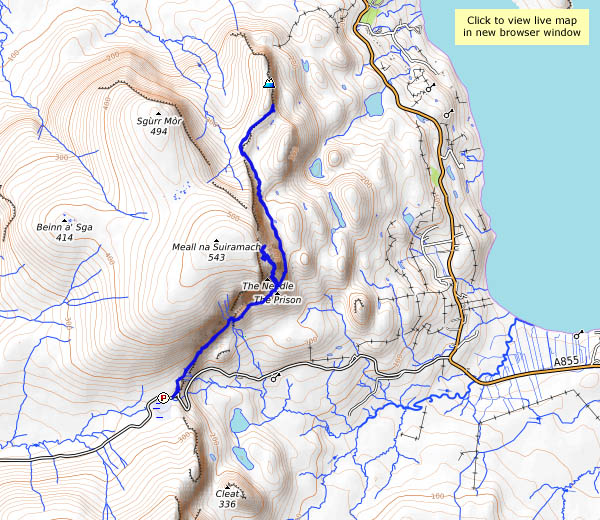
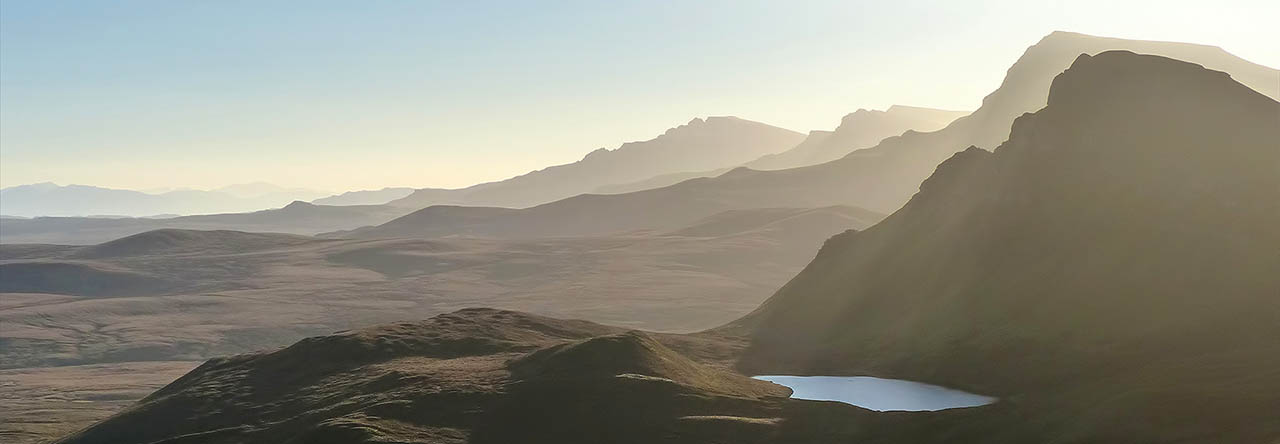
There’s a fairly straight, level and most enjoyable route to Sròn Vourlinn from the top of the road from Staffin to Uig – unfortunately, everyone else agrees with me, as the first part of the walk is also the route to the much better-known Quiraing. We’ll try to avoid the crowds, and begin the walk on the path from Loch Langaig, down on the main road near Flodigarry (see also “Quiraing – the other way“). The path ascends steadily until it reaches a cairn marking a sharp right turn, in a hollow below black cliffs and startling pinnacles. There are other walkers around – one or two have used our path from Loch Langaig – but when we continue along the ridge to the north, we’ve got the hills to ourselves. The views are tremendous and extensive, from the mainland mountains to the east, through a far-reaching seascape to the hills of the Western Isles. In the middle distance, with Lewis on the horizon, is Rubha na h-Aiseig. To the south, down the Trotternish ridge, the landscape is a tangled confusion of crags, cliffs and pinnacles. Just don’t get too close to that vertical cliff edge!

View OS map on Streetmap http://www.streetmap.co.uk/map.srf?X=145733&Y=870841&A=Y&Z=120

Ferry Point

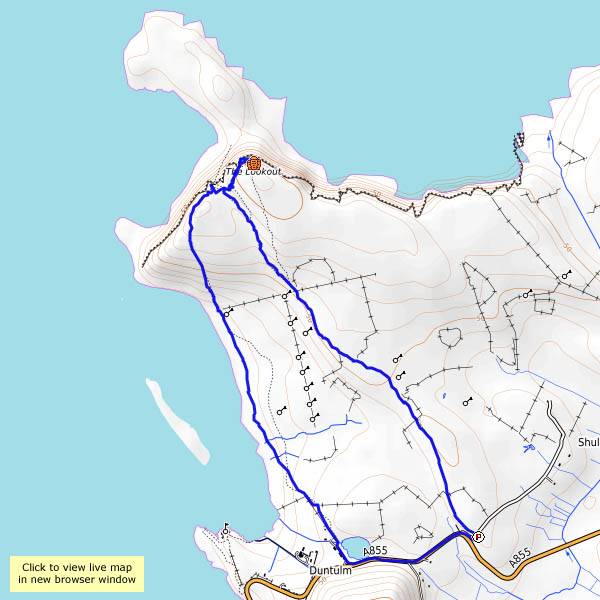
24th August: It’s Rubha na h-Aiseig on the map – and just a mile further north is Eilean Trodday. The island was inhabited once – was this where the ferry departed? There’s no road, and barely a path, but the route is fairly obvious. The descent from the rocky cliff-top to the shore follows what seems to be a made way – a well-graded route with a single zig (or zag?) close to its foot. There was no shortage of tourists on the single-track road round the north of Trotternish (16-registered hire cars, terrified expressions on their drivers’ faces… I’m guessing, of course) but on this short walk, we’re alone – apart from one solitary sheep, lots of gannets, and the crew of a passing yacht. After two days of motorways and busy roads, it’s perfect!

View OS map on Streetmap http://www.streetmap.co.uk/map.srf?X=143933&Y=875636&A=Y&Z=120

Lightspout Ridge

There’s an obvious and inviting route up this ridge, prominent above the Cardingmill Valley. It’s one of those paths which become fainter as height is gained – it’s quite a pull up to the rocks at the top. Beyond, the path is very faint, walked mainly by the four-legged locals, I suspect, and for a little while, I’m wallowing in luxuriant purple heather. The ridge is unnamed on the OS 1:25000 map, but I find myself looking down into the Lightspout Hollow, whose waterfall is a mere trickle in this summer weather. Perhaps this is Lightspout Ridge? (above the reservoir, it’s “Cow Ridge”, but that doesn’t seem an adequate description). A more obvious path now takes me down to the path above the waterfall, where, having met no-one since beginning the ridge path, I’m back amongst the (relatively speaking) crowds. I’ve done this short walk on my own – the others will be in the tea room, so I’d better not hang about now…

View OS map on Streetmap http://www.streetmap.co.uk/map.srf?X=343450&Y=295043&A=Y&Z=115

Knighton to Bucknell

We left the car at Bucknell railway station, and caught the 1052 train to Knighton, all of 4.25 miles away (though we’ll walk more than twice that to get back). That ought to be “Knighton International” – the platforms are in Shropshire, the town (and the first few yards of our walk) in Wales. Crossing back into England, we’re soon looking down on the Teme valley, beside Offa’s Dyke, before turning right at an upland crossroads (crosspaths?) to head through high breezy grassland which ends at Bucknell wood. The descent through the woods towards the village (every bit as quiet as Clunton and Clunbury, Clungunford and Clun, apart from the occasional train) is much more pleasant than might be imagined – a good walking surface and lots of variety. There were showers about, which we mostly managed to avoid – it didn’t feel at all like early August, but it was a good day to be out on these lonely hills.

View OS map on Streetmap http://www.streetmap.co.uk/map.srf?X=332260&Y=273831&A=Y&Z=120

Apedale, Wensleydale – Swaledale

Tuesday pm: There’s a most attractive “Apedale” along the road from Much Wenlock to Church Stretton (are Shropshire’s dales England’s southernmost?), and another Apedale in Staffordshire, home of a splendid 2′ gauge railway. This one’s a very minor, little-known dale in Yorkshire, and the coincidence is just that – quite accidental. The rough track we’re walking would take us over to Swaledale: we’ll stop at the watershed, admire the views, and turn back (walked far enough for one day). We had thought of making a circular route, following the ridge (a flat peaty moor) back round, but there was no path and the going looked hard on deep tussocky grass.

Yorkshire’s Apedale was most enjoyable, and retracing our steps was no hardship. It’s not the most spectacular part of the dales, but it’s very quiet – the only sounds are those of the birds (there are hundreds of rabbits, but they’re silent, and the sheep aren’t saying much). And what birds! A cuckoo, several lapwings, and more curlews than I’ve seen and heard for many years. Their rising, bubbling cry screams “lonely places”, sending a real shiver down the spine (try it: listen to the recordings on the links below). Sadly, they don’t like having their picture taken.

British Birdsongs: Curlew
RSPB: Curlew

View OS map on Streetmap http://www.streetmap.co.uk/map.srf?X=402010&Y=494612&A=Y&Z=120

The Closed Severn Valley Railway

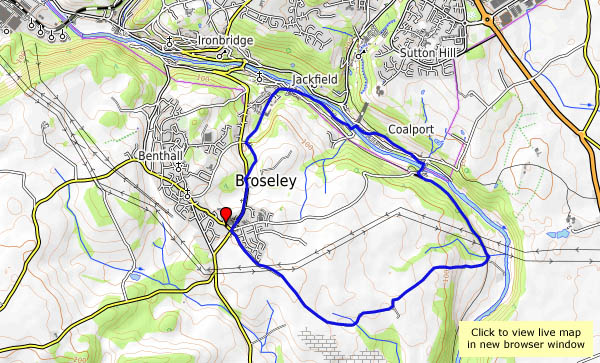
North of Bridgnorth, the track has gone; for much of the way to Coalport, it’s a private road with permissive access, a rough but very walkable surface, and plenty of shade. We’ll need that – not a cloud in the sky. The last train passed through Linley station more than 50 years ago, and given that there are no public roads, this stretch of the valley feels closed off from the outside world. It’s very quiet – just birdsong, contributing to the peace rather than disturbing it (and the odd cyclist, one or two walkers, a gaggle of canoeists and couple of farm vehicles – but who’s counting on a day like this?).

It’s downhill all the way from Broseley to the river; the railway track is more-or-less level. To get to the bus stop in Bridgnorth, we face a long flight of steps, which comes as a shock to the system after about 8 miles of walking. With 45 minutes to kill before the next bus, a pint will be a perfect remedy…

View OS map in Streetmap http://www.streetmap.co.uk/map.srf?X=369185&Y=297306&A=Y&Z=126

Benthall Buttercups

It’s a beautiful afternoon – too good to stay at home, too warm to walk far in the sunshine. If we leave the car at Benthall Hall we can do a circular walk, much of it in the very pleasant woodlands of Benthall Edge and nearby. It’s lovely down in the woods today, as the song goes, but we must leave them to walk back through the fields towards the car – fields full of buttercups, yellow in all directions.

View OS map on Streetmap http://www.streetmap.co.uk/map.srf?X=365735&Y=302716&A=Y&Z=120

Magpie, Titterstone and Clee

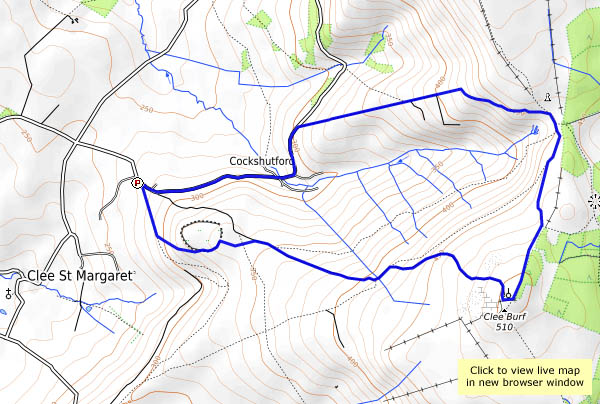
Walking in south Shropshire with a “railway” friend: one who appreciates the interest in the remnants of industry in these very quiet hills. They’ve been extensively quarried for stone – parts are still being worked – and the coal measures were exploited too, many years ago. There are former railway trackbeds, of the standard gauge line which took stone down to Ludlow, and the narrow gauge lines which threaded the workings. Magpie Hill’s stone went by a different means and route – an aerial ropeway took its stone down to Detton Ford, on the long-gone CM&DP. The concrete bases of the pylons are still in place, and there are bits of rail here and there, mostly in use as fence posts and similar. Long-abandoned concrete structures stand here and there, slowly crumbling, like the remains of some lost futuristic city. They can feel rather spooky when the mist comes down, but there’s no such nonsense on a fine sunny June day.

View OS map on Streetmap http://www.streetmap.co.uk/map.srf?X=359845&Y=276831&A=Y&Z=120