Mucklewick in May

Sounds charming, doesn’t it? We started out from The Bog… It was warm, clear, sunny – beautiful! Gone are the pastel shades of the winter months – it’s all in technicolor today.

We leave the Bog car park by the new path beside the road, heading north-east on a walk that would be south-west of our starting point. There’s method in our madness – we’re avoiding a short stretch of path that can be seriously muddy. Later, as we descend from the ridge, a fairly comfortable rock beneath The Rock provides us with table and chairs (I exaggerate) for lunch – a near-perfect spot, away from the wind (a light breeze, very welcome later in the afternoon) and the gunfire. It’s not the quietest part of the county…

Quiet tracks (on the opposite side of the ridge to the shooting range) and a very minor road take us down to the West Onny valley, then via Nind back up onto the hills. Mucklewick Hill is another pleasant spot (enjoying that breeze now) for the last of the day’s provisions before, after a short descent, the long gentle rise to tea and cakes at the Bog Centre (highly recommended!).

The Bog Visitor Centre


Wenlock Priory: dodging the showers

More than half the abbey has gone, but what remains is a pleasant spot for a brief exploration on an afternoon when heavy showers threatened between bursts of sunshine. The threat was not followed through, apart from a few spots in the wind, but the sunshine did its best to confound. There are some nice little details in the stonework, and the topiary is wonderful!

Wenlock Priory EH


Steam in the Landscape

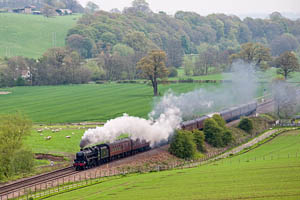
44932 - Steam in the Landscape thWe’ve had one or two steam-hauled specials in Shropshire recently – this would be the last for the immediate future. It should have been a Britannia, then it was going to be Duchess of Sutherland. In the end, they were all indisposed, and the duty fell to humble Black 5 no. 44932 – an ideal subject for “steam in the landscape” shots…

(A few) More photos and video at “Steam in the Landscape” on Geoff’s Rail Diaries

Walking from Wenlock to Broseley

Tea and cake at Benthall Hall…

We’ve done it before, but last time, the Hall was only open at weekends. Now, it’s open (March to October – closed in the winter) on Tuesdays and Wednesdays too. There’s a tea room, with some tables and seats outside – and it’s just nicely half-way on this walk – perfect!

There are only four buses each day, but the Arriva no. 88 service is ideal for this one (and there’s entertainment value in the negotiation of some of Broseley’s narrower streets, where “anywhere” is the rule for car parking).

There are several possible routes from Benthall Hall to Broseley; most involve field paths and tracks before walking through the streets. On this occasion, we walked down surfaced lanes, to enter Broseley by the “Fiery Fields”.

NOTE for tea drinkers: the tea room is inside the hall, which would require payment of an admission charge; the outside area is not accessible though the hall, but whether one should pay, I’m not sure – we’re members anyway. The Hall is well worth a visit – but muddy feet (and ours were) would not be appreciated…

Bus timetable | Benthall Hall NT

Callow Hollow

The Long Mynd’s eastern valleys are several and varied – some are valleys, some (most) are batches. There’s a dale and a gutter too – and a couple of hollows. If we count the side valleys off those main valleys… Perhaps not. I’ve been exploring the Mynd for many years, but until very recently, I had not quite digested one rather odd fact born out by the 1:25,000 map: many (perhaps most) of those side valleys have names – except for Ashes Hollow, whose side valleys are nameless. (I’m sure they’re not, but there are no names on the map).

Ashes Hollow runs down to Little Stretton. Next, joining Ashes at its foot, is Small Batch (aptly named), then there’s Callow Hollow. Ashes Hollow is perhaps the next-best known after Cardingmill (Valley), not least due to the camp site occupying its last few yards. Callow is one of the least known, despite being of comparable scenic value, largely because, until relatively recently, there was no easy access to its foot. We met no-one else on foot throughout the walk (just one cyclist, and a farmer in his pickup). And, like so many of these valleys (batches, hollows etc….), once we’re just a few yards in, there’s nothing man-made in sight, until we reach the plateau and the road.