It’s going to be wet and windy tomorrow – and Christmas is looming… Today – quiet; fresh air and bright sunshine – out with the camera near Wenlock and Ironbridge


.
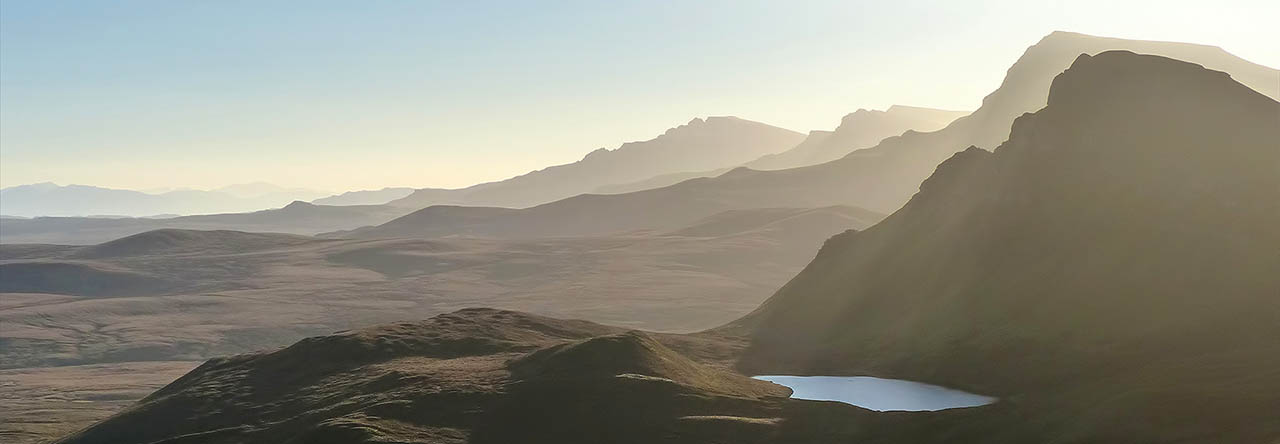
It’s going to be wet and windy tomorrow – and Christmas is looming… Today – quiet; fresh air and bright sunshine – out with the camera near Wenlock and Ironbridge
.
A bright afternoon – lots of blue sky, mild, a light breeze… It nearly blew us away as we were putting our boots on, and at first it didn’t feel quite so mild, but once we were warmed up, it was a very pleasant afternoon on the high moorland. A fleet of spaceships scudded around in the northern sky (too substantial, surely, to be clouds?). The light gradually softened and warmed as the sun (and wind) dropped – it was setting as we arrived back at the car. Perfect timing!


It was Dawley Parva on the old 1″ maps, but today it’s more prosaic. The area between Coalbrookdale and Dawley is a tangle of old ways, many of which were originally the routes of pre-railway age wagonways. The last of these in the vicinity closed as recently (if that’s not the wrong word) as 1932, and their trackbeds, where they remain, make good footpaths, well-engineered with gentle gradients. The pools at Little Dawley were associated with the canal which once ran to the head of Coalbrookdale – today they are attractive and unsuspected features of the local landscape, which must have looked very different during the industrial revolution. The uppermost pools – “The Dandy” and Castle Pool were canal feeders – and yes, there was a Dawley Castle. It was a casualty of the civil war, and any ruins that might have remained were buried in the slag of the ironworks (long gone) which later occupied the site.
Our route back to Coalbrookdale takes us along dark hidden lanes in the Lightmoor area – Holywell Lane leads to Stoney Hill, where the landscape is changing rapidly under new housing development. Crossing the by-pass, we then descend through the damp woodland of Vane Coppice – the sun dropping behind the hills as we approach the coke hearth and the car.


The sunlight was strong; its colour warm, the air temperature less so. It would be a shame to waste the possibilities – an hour or so at Blists Hill might be worthwhile.


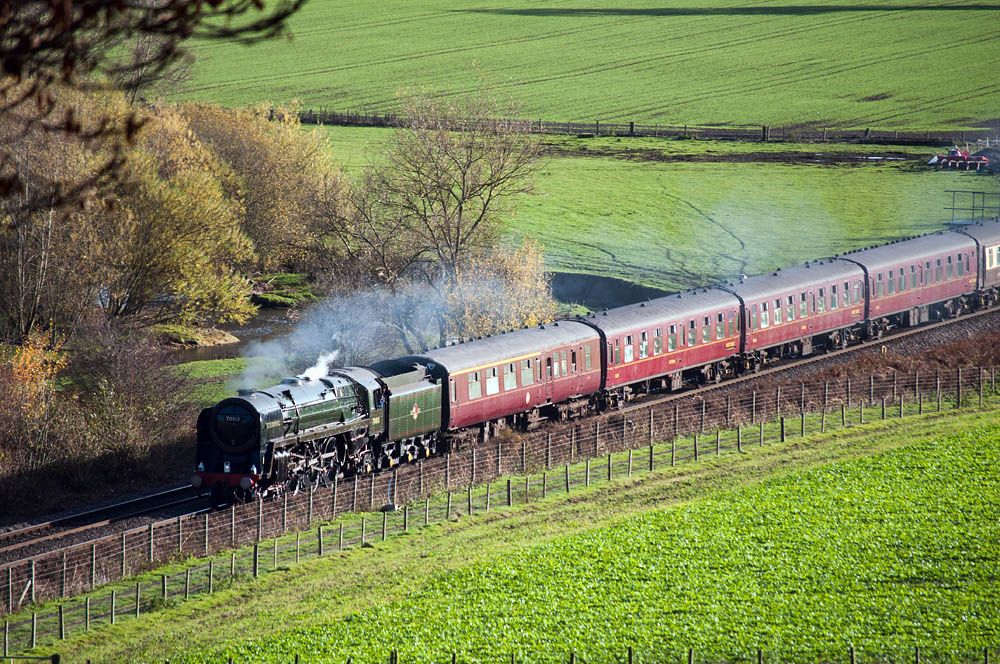 The conditions were, for the last day of November, near perfect for a photo of 70013 “Oliver Cromwell”, following in the steps of last week’s run of “Britannia”. The air was cold, the sunshine bright and directional, ready to light the steam nicely from behind. The train was about an hour late (not its fault), but it was going well as it approached in the distance. Then, in prime position for our photos, the driver closed the regulator (on a 1 in 112 uphill stretch – one of the steeper parts of the long climb to Church Stretton). Once behind the trees, the regulator was opened again, and stayed open away into to the distance, including the short downhill stretch to Craven Arms. We could hear it as well as see it. So what went wrong? (I well remember the driver of 46229 closing the regulator briefly on the last 1/4 mile of so of the southbound climb to Ais Gill,
  just to spite the gallery of photographers… Surely not?)
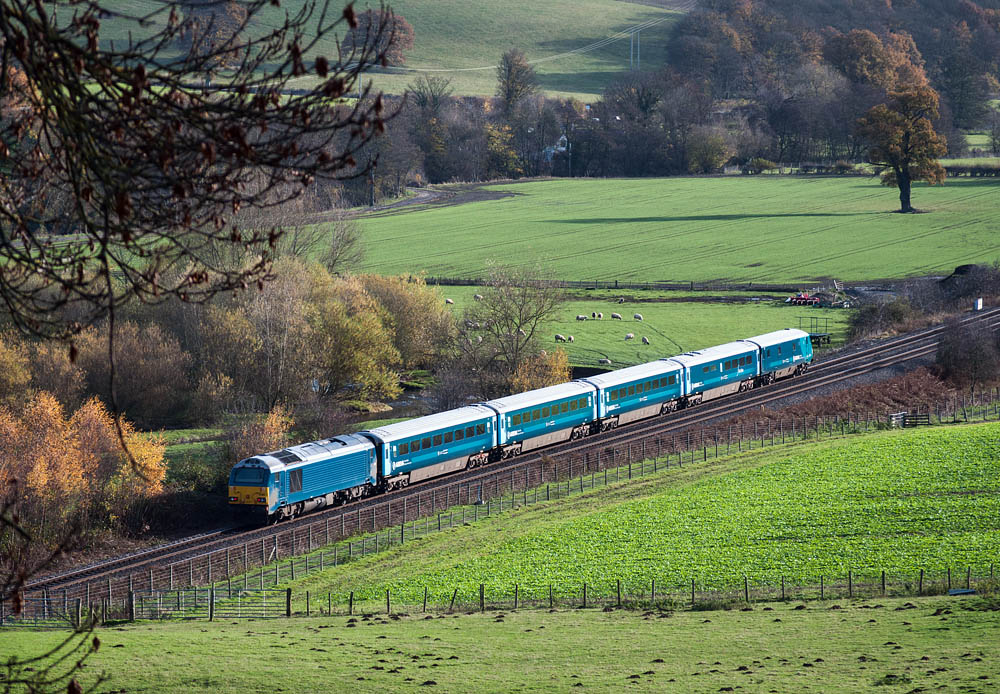
The WAG train was a minor bonus – made a change from the usual endless procession of class 175 units.
A Salvation Army rock group perhaps? No, just a rock – an interesting clumpy outcrop on the northern edge of the Hope Bowdler hills near Church Stretton, which provides an airy viewpoint and a good objective for a short walk. With clear blue skies, bright sunshine and light winds, it was too good to stay at home.


A good day for exploring the dingle and the woodland beside the pools. There might be some interesting fungi under the trees. The path beside the Big Pool is closed, but the public footpath through the asparagus farm leads us across the road to Comer Wood. There’s a thin film of ice on Seggy pool, barely visible – but doing odd things to the reflections.


 That’s Britannia – first of the class, and first of 999 BR standard steam locomotives. Today it was hauling the “Cathedrals Express” from Waterloo to Shrewsbury, via the Severn tunnel and the “North and West” route through Hereford. Unfortunately, a preceding freight train broke down, causing substantial delays to services – and to the special. It was around 70 minutes late when it passed Stokesay – the light was going rapidly. So was Britannia…
Brown Clee, that is, Shropshire’s highest. It wasn’t just a clear afternoon – there was plenty of blue sky around too – apart from over the hill. Occasionally a shaft of sunlight would break through like a spotlight, but most of the time we had to be content with the views of the sunlit distance. The Brecon Beacons are just visible – 55 miles to the south-west.
This route – just 3 miles in total – starts from the phone box. The box itself is redundant – not only do we all have mobiles now, but it’s been superseded by a modern al fresco alternative. Happily, the old red box lives on as the “Little Red Book Stop”. The sign on the door says
“Please…There’s a handy log beside the box…


…and a need for a breath of fresh air. High ground between Much Wenlock and Broseley; it’s cool, still and clear, though the lowering sun begins to accentuate a haze to the south-west, where the ridges and hill-tops seem to go on for ever.


