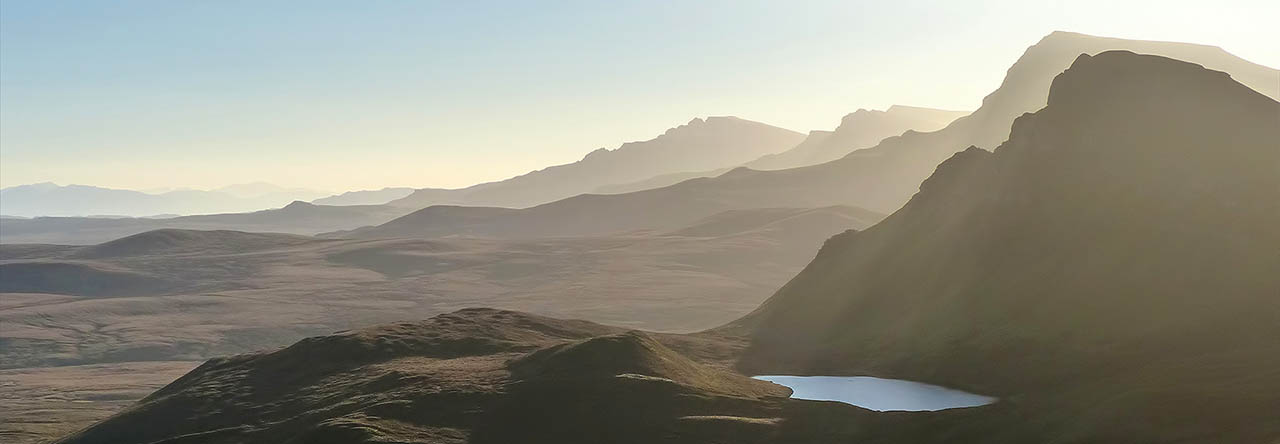
North of Portree there’s a ridge – a line of hills frequently seen in photographs but, I suspect, infrequently visited. The photographs in question are of the Old Man of Storr, with the Storr Lochs and the hills in question behind. The highest point, Sìthean a’ Bhealaich Chumhaing, is just 1286′ above sea level – but that sea is less than half-a-mile from the summit – it’s a splendid airy viewpoint which makes this scenic walk well worthwhile.
I’d be doing this one on my own (just as well…). The household authorities were going shopping in Portree – if I left my car at the north end of the Storr Lochs, I’d have a lift to the start. I’d rather have done the walk in the opposite direction, but that wasn’t going to be quite so easy to organise. Having done the walk, I realise it would be much better walked north to south – route-finding would have been easier (there are a couple of moderately tricky spots going south-north, where it’s important to find the right places to descend from lines of crags). It would have involved less ascent too!
I set out from Portree along the very pleasant path to the Black Rock, continuing by the curiously named “Bile” (a raised beach, apparently) to the start of the ridge proper. There is no obvious path over squelchy moorland which must be crossed before reaching the grassy sheep-cropped ridge, where no path is needed – it’s excellent walking. The main peak comes first, followed by two lesser tops, Creag Ulatota and Fiurnean. The last stretch back to the power station road is a long slog across a pathless sodden moor of tussocky grass, making for slow and hard going, and damp feet. Only once did I see a bootprint. Back at the car, there’s a sign – the Scottish Rights of Way and Access Society proclaims a footpath to Portree, 6.5 miles. Wishful thinking! If there was a path, it would be a truly excellent walk. And it may be 6.5 miles as the crow flies – but I reckon I walked nearer 8…