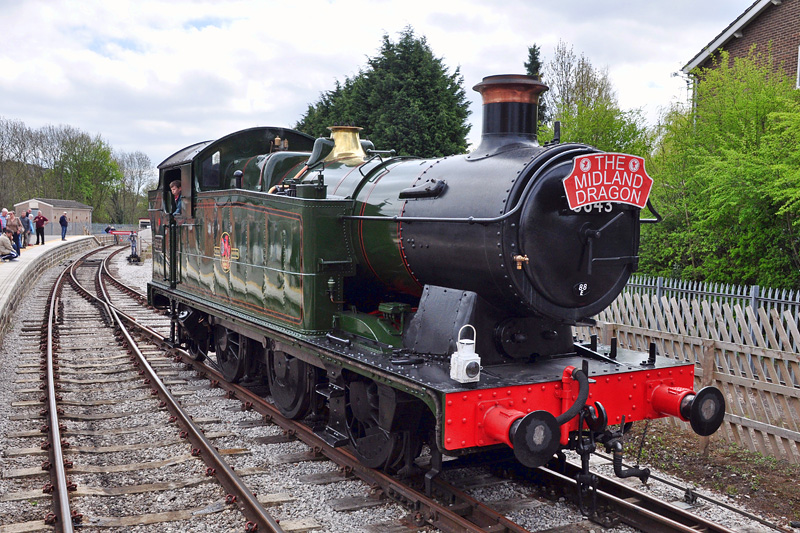
 Main line steam returned to the Ecclesbourne Valley Railway for the May Day bank holiday weeked, in the shape of GWR 0-6-2T 5643 – accompanied by a fine pair of Barclays. For a full (ish) account and more pictures, visit “Ecclesbourne Again” on Geoff’s Rail Diaries
Author: geoffspages
On the Mynd again
Wall-to-wall warm sunshine – blue skies, clear air, a pleasant breeze – perfect! It’s been a long time coming. Ideal conditions for a walk from Little Stretton, up beside Small Batch to Pole Bank, back down the Ashes Hollow. A red kite circled, then descended into Callow Hollow; later he appeared again over the ridge, and we saw him one last time as we walked down the quiet valley (maybe three different kites? I doubt it). He didn’t stay – left it for us, the sheep and the buzzards. Other than the aforementioned, and lots of small birds, singing loudly, we had the Ashes Hollow to ourselves. For much of the descent, there’s nothing man-made in view (other than the path) – it can sometimes be hard to believe we’re in the English Midlands.


They’re back!
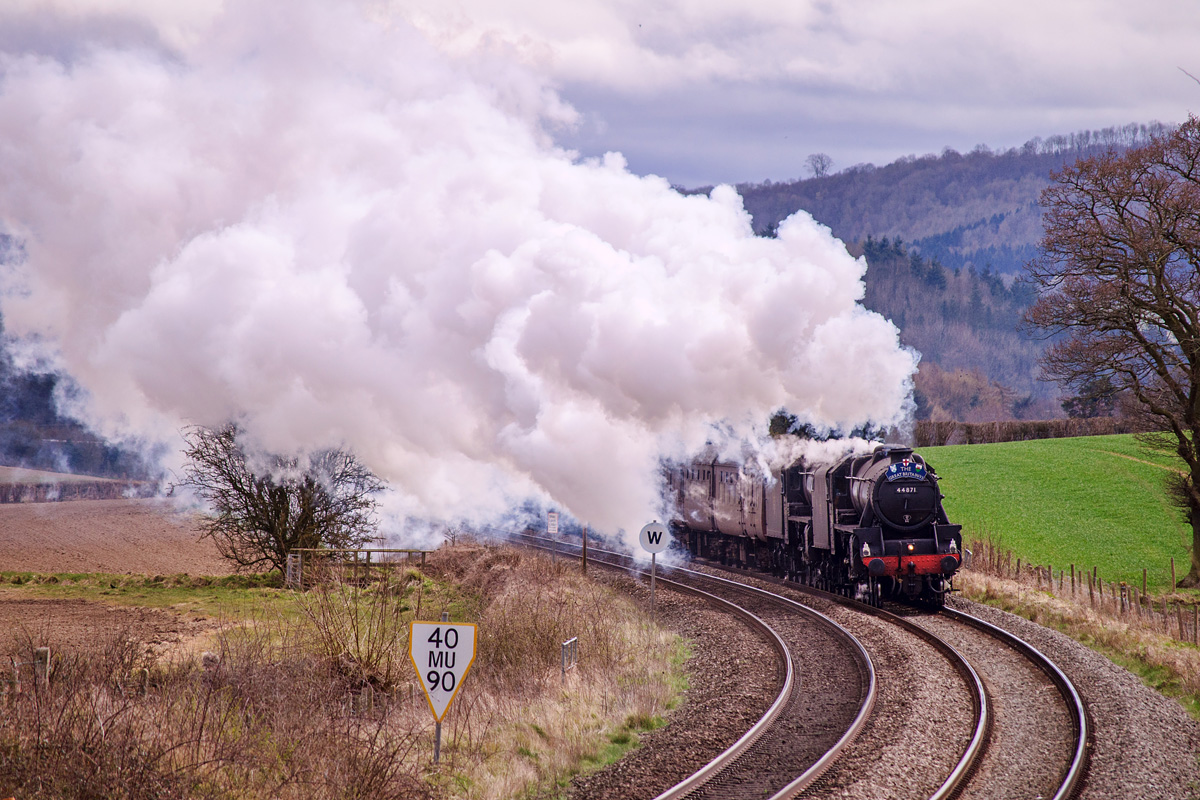
44871 and 45407 came back through Shropshire today, hauling day 3 of the “Great Britain VI” – and made a fine sight a couple of miles north of Craven Arms, on the climb to Church Stretton summit. For more pictures and video, visit “A Glimpse of the Great Britain VI” on Geoff’s Rail Diaries
The 1960s Railtour
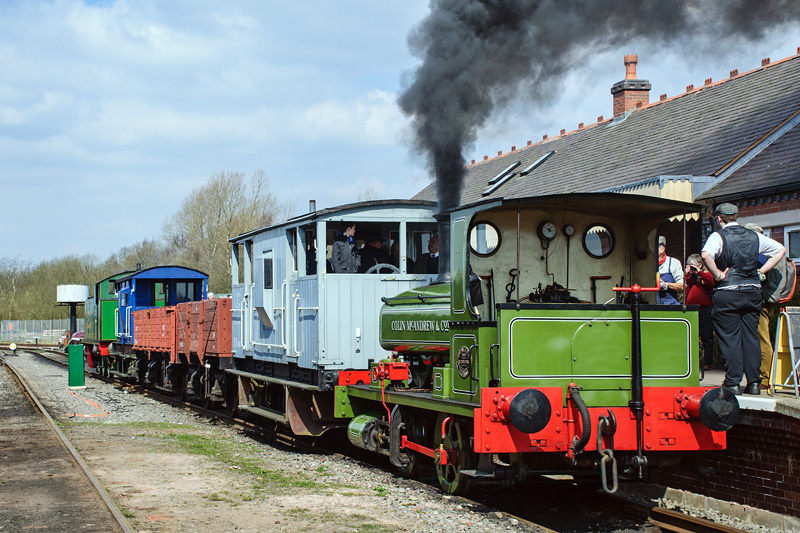 For more on yesterday’s fun at Chasewater visit “The 1960s Railtour” on Geoff’s Rail Diaries
(Right) Colin McAndrew is still smoking well on his return to Brownhills West, at the end of the trip
Troublesome trucks
 Thomas was always having trouble with trucks. Today, it was Colin McAndrew’s turn. It’s the IRS* AGM, held at the Chasewater Railway – they’ve organised a “60s style railtour” for our entertainment. Older members (that’s 99% of membership these days) will have fond memories of such events – e.g. “Farewell to Steam at Corby” (that’s 40 years ago, which is a sobering thought). The trouble is, of course, not the trucks themselves but their contents. I don’t remember anyone falling out at Corby, nevertheless, today’s rule (happily, the only one) was “no standing up while the train is in motion”. We all did as we were told.
Colin McAndrew is a diminutive Barclay 0-4-0ST (1223 of 1911), who is a serious contender for my wife’s affections.
*IRS = Industrial Railway Society (our transatlantic friends will possibly be relieved to know that…)
A spring evening
Ironbridge, in the warm evening sunshine. Just a couple of weeks ago, It felt as though it would never happen…


Oswestry and Llanymynech
Dodging the rain in western Shropshire – a very brief visit to the Cambrian Railways at Oswestry, and (via Blodwell Junction – no, it’s not on the way) a quick exploration of part of the Limeworks Heritage Area at Llanymynech. Must go again…


The Midlander

A pair of Black 5s going very well on the climb to Church Stretton. For more pictures and video, visit “The Midlander” on Geoff’s Rail Diaries
Wetmore and The Speller
A walk from Aston Munslow into quiet country on the Wenlock Edge. The Munslows are on the Corvedale road, which isn’t particularly quiet, but through Millichope Park and down into Hope Dale, there’s mostly just birdsong, plus a few sheep and a noisy dog at the farm. A rustle in the trees below gave us a glimpse of a deer, and a red kite wheeled for a few moments before disappearing behind the trees – neither were there long enough, or near enough, for a photo. The kites are coming further and further east from their mid-Wales stronghold – there was one over our house yesterday, a real “first”.
The Speller? Clearly labelled as such on the OS 1:50000 maps, and their 1″ predecessors, the name has intrigued me for many years. There’s a Speller Brook, which flows down through Millichope Park, and Speller Coppice is an area of woodland in these parts. Other than that, I’ve no idea what it is, or refers to.
There were still patches of snow here and there, where the deepest drifts would have been. Still quite a bit on Brown Clee too, though the air was so hazy we could barely see it. It’s still cold, too – very few signs of spring in the Shropshire hills


A fortnight later
It’s two weeks since the snow fell, and there’s still plenty of it on the Shropshire hills. But spring is coming, however belated. There was little more than a breeze on top, still from a cold quarter, but out of the breeze it was pleasant in the warm sunshine.


