That’s what it’s doing! We’re walking down to Coalport for tea and cakes, and everything is bursting into flower – the blackthorn, the bluebells, the garlic and the coltsfoot. As we drink our tea, a primrose flutters past – or perhaps it’s a brimstone butterfly.
Category: Walks
Short walks with photos and a Google map.
Priors Holt to Black Knoll
The day changed: it was bright and sunny when we left Priors Holt (or “Witchend” to Malcolm Saville “Lone Pine” afficionadoes), but the forecast was right. It was windy too – we’d planned a different route from Black Knoll, but the wind was strong and bitter on the exposed south-eastern flank of the Mynd – much more so than on the ridge path – so we retraced our steps to the forest. A red kite wheeling nearby was never close enough for the camera, and the three deer in the woods, just yards away, were gone in seconds. No photos of them either…
View OS map on Streetmap http://www.streetmap.co.uk/map.srf?X=340535&Y=289336&A=Y&Z=120
Back to the Munslows
A pleasant five-mile stroll in a quiet part of the Wenlock Edge – and once we’re away from the road, it really is quiet. The birds are singing, but that doesn’t count as noise, and the only other sound, as we approach the highest parts, is the gentle rustling of a very light breeze in the trees. It’s clear too – the Black Mountains stand out to the south-west. At home, the grass needs cutting, but it will have to wait…
View OS map on Streetmap http://www.streetmap.co.uk/map.srf?X=351485&Y=287911&A=Y&Z=120
Mary Knoll – 40 years later
We’ve walked many times in the woodlands to the south-west of Ludlow – this walk was probably our first. Today we retraced our steps, visiting Mary Knoll Valley for the first time in 40 years. The valley, with its pleasant but well-hidden little stream, cuts deeply through the land. Near its head, there’s a herd of deer, and beyond Mary Knoll itself, there are woodpeckers hammering away in the trees. Earlier, as we drove towards Ludlow, we’d passed a pair of red kites, wheeling in the warming air. Oddly, this walk seemed shorter than it was in 1976, though the trees have grown, and Ludford weir has been tidied up. How will it all look in 2056? (Will we care?)
Photo note: it was a dull, slightly murky day in 1976, so I used a roll of FP4 (monochrome) film – which I reversal-processed for black-and-white slides. I was rather pleased with the results, though I never tried it again…
View OS map on Streetmap http://www.streetmap.co.uk/map.srf?X=349675&Y=273336&A=Y&Z=120
Telford to Ironbridge – along old lines
Monday: We’ve taken the bus to Telford town centre, and we’re walking back. For roughly half the distance (just over 6 miles in total) we’re on, or close to, the Silkin Way, which follows the track of the old Coalport railway. In places, its predecessor, the canal, is also still in water. We leave the trackbed of necessity – there’s a gap, where it used to cross the railway to Ironbridge power station – both now out of use. From this point (near to the old windmill), we’re roughly parallel to the Ironbridge line, and as we descend from Lightmoor, we join the track of an older way – one of the many pre-railway age tramways that ran in these parts. Arriving in Ironbridge, there’s time for tea and cake…
View OS map on Streetmap http://www.streetmap.co.uk/map.srf?X=369040&Y=306086&A=Y&Z=120
Mitchell’s Fold and Bromlow Callow
We’re on the western fringe of Shropshire today, in a part of the county where the distant past has some significance. Mitchell’s Fold stone circle is a well-known ancient monument, whose location on this high grassy ridge makes up for a lack of stature – it’s not Stonehenge. Walking on, we arrive at Castle Ring (a pretty straightforward name for a hill fort) – again, not the biggest in these parts, but its situation is dramatic. We take a detour on the way there, to visit the top of Rorrington Hill. No cairn or OS column – the highest point must be found by guesswork. Eventually, we come to Bromlow Callow. I’ve no idea what its history might be, but the round hill topped by a clump of tall trees makes it a distinctive landmark in these parts. The view would be tremendous on a clearer day – it’s hazy again, and we can only just make out the Long Mountain (it may be long, but it’s hardly a mountain) barely five miles away. Our return takes us to the highest point of Stapeley Hill – again, it’s not a mountain, but at least its highest points are marked by rocks and cairns. We could have had better views today, though we did see a hare – he must have been just a few yards away when we startled him. With sunshine and light winds, it’s been another great day out on the hills.
Or view OS map on Streetmap http://www.streetmap.co.uk/map.srf?X=331605&Y=299611&A=Y&Z=120
Watercolour days
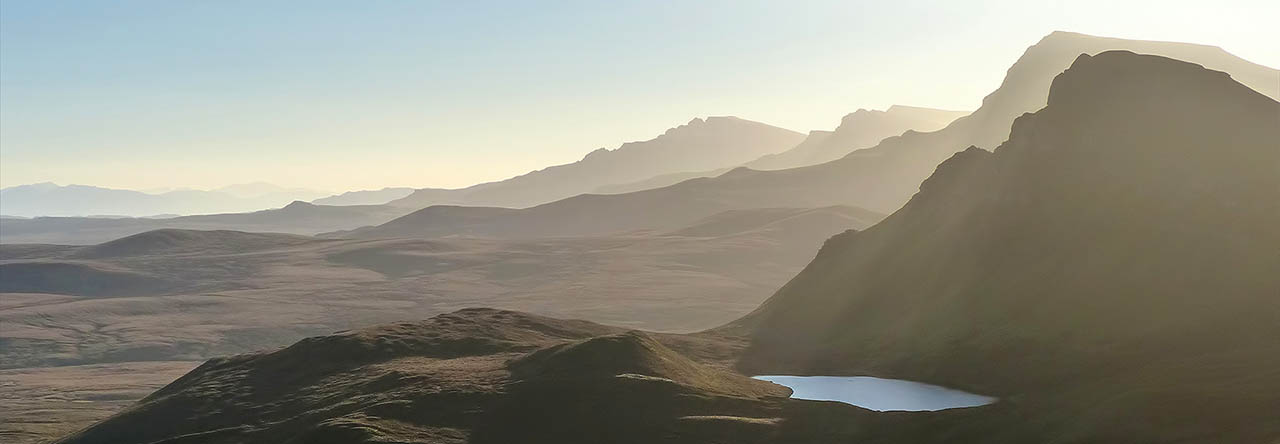
Friday: spring is in the air – and there’s a spring in our steps. It’s not warm, but this is the first day we haven’t needed gloves, scarves, hats etc. With the change in weather has come a haze, shortening our horizons and fading them to shades of watercolour. We’re following a new (for us) route, using a permissive bridleway and gentle gradients to reach Boyne Water, an attractive pool which is larger than one might expect, so near the summit ridge of Brown Clee. Minutes later, we exchange the eastern view – pleasant gentle countryside, for the western view – the indistinct pastel-blue ridges of the border hills. It’s good up here on a day like this, but we can’t stay, and we’re soon threading our way back down between moss- and lichen-clad trees, towards the car and the short journey home.
Or view OS map on Streetmap http://www.streetmap.co.uk/map.srf?X=360140&Y=285876&A=Y&Z=120
Under a clear blue sky: Lyth Hill
We needed to collect a package in Shrewsbury, some time in the latter part of the afternoon. One of us had thought about calling in on the shops, but the weather was much too good for that. Lyth Hill, just south of the town, would provide us with a reasonable walk. It’s hardly worth calling a hill, barely 550′ at its highest point, but its isolated position provides a panoramic view of the south Shropshire hills, from the Wrekin through the Stretton hills to the distant (and snow-covered) Berwyns. We encountered the noisiest and most insistent sheep we’ve met for a long time (“wave upon wave of demented avengers”), a fine herd of deer (who, fortunately, can’t read the sign at the end of the lane proclaiming “venison for sale”), innumerable horses, and on Lyth Hill itself, one of the highest concentrations of dogs and their walkers for many a mile. As for the fields of Exfords Green – they’re the greenest we’ve seen for a long time. It must be spring.
Or view OS map on Streetmap http://www.streetmap.co.uk/map.srf?X=346640&Y=306321&A=Y&Z=120
The other edge at Wenlock
The western escarpment is much the better known at the northern end of the Wenlock Edge, with some very pleasant walks from the popular NT car park at Much Wenlock. This route, to the eastern ridge, is less well-known and much quieter. We walk beside the old railway line and through fields, along interesting little wooded pathways. Between the heavy clouds (we’ve managed to dodge the showers) the sky is blue – the landscape is a patchwork of light and shade today.
View OS map on Streetmap http://www.streetmap.co.uk/map.srf?X=361295&Y=299171&A=Y&Z=120