Staffin shore: Orcas

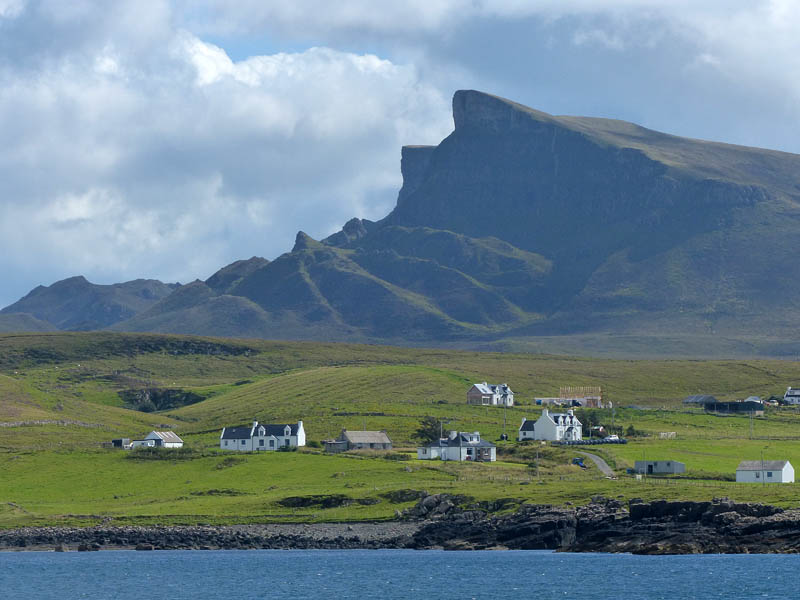
27th August ctd: After our visit to the Loch Shianta, we drive on to Staffin slip, park the car and wander across the saltings to the rocks. Rather than remain at our usual spot, we continue along the grassy upper shore below the cliffs. Soon, we can go no further – the jumble of huge boulders makes the shore virtually impassable. We stop for a while, and gaze out so sea – what’s that? Large fins break the surface… Glimpses of white patches identify them as orcas, also known as killer whales. There are no acrobatics, but they’re there for the best part of 20 minutes (the YouTube video below contains the edited highlights…).

Later that day, we’re back on the west side of Trotternish, watching the sun setting behind Harris, in an almost-perfect demonstration of the curvature of the earth.

Catholic tastes

Towards the end of the afternoon, it occurred to me that, over the weekend, I’d seen a quite amazing range of railway activity. Yesterday we started with the Statfold open day – rather a soggy one, sadly,  though the weather had changed completely by the time we saw Princess Elizabeth hurrying southward from Church Stretton, shortly before 6pm. This afternoon we were at Nantmawr where we had a ride on an ancient DMU, barely half-a-mile down the last remaining section of the former “Potts”. The main reason for our visit however was to see the incredible collection of industrial monorail equipment, which until very recently was in storage at Blaenau Ffestiniog.

More on the above will appear on “Geoff’s Rail Diaries” in due course, though I’m acutely conscious of a growing backlog. So far as this blog’s concerned, we were still on Skye until this entry. I hardly dare say it, but I could do with a few more rainy days…


The enchanted loch

27th August: The sign at the little parking place describes Loch Shianta as “The Enchanted, Holy or Magical Loch”. There’s certainly something magical about the water in this well-hidden pool – it’s the clearest water I’ve ever seen, with a curious turquoise tint. Is it something in the water, or just its rocky bed? Sadly, neither the depth nor the clarity come through in the photos – it has to be seen to be believed.

The path down to the loch is short and well-made, with little plaques every few yards, mostly in Gaelic. “Gabh seo, a ghaoil” seems to translate (Google) as “take this, love”. Is that perhaps too literal? Though it’s late in the season, this is a colourful walk, with plenty of knapweed and scabious, not to mention a patch or two of ragwort. Just off the path. there’s a super small colony of fly agaric (“flying Eric”, as my nephew once misheard), and as ever, there are great views of islands and the highlands.
Staffin Ecomuseum

View OS map on Streetmap http://www.streetmap.co.uk/map.srf?X=147067&Y=869865&A=Y&Z=115

Sròn Vourlinn

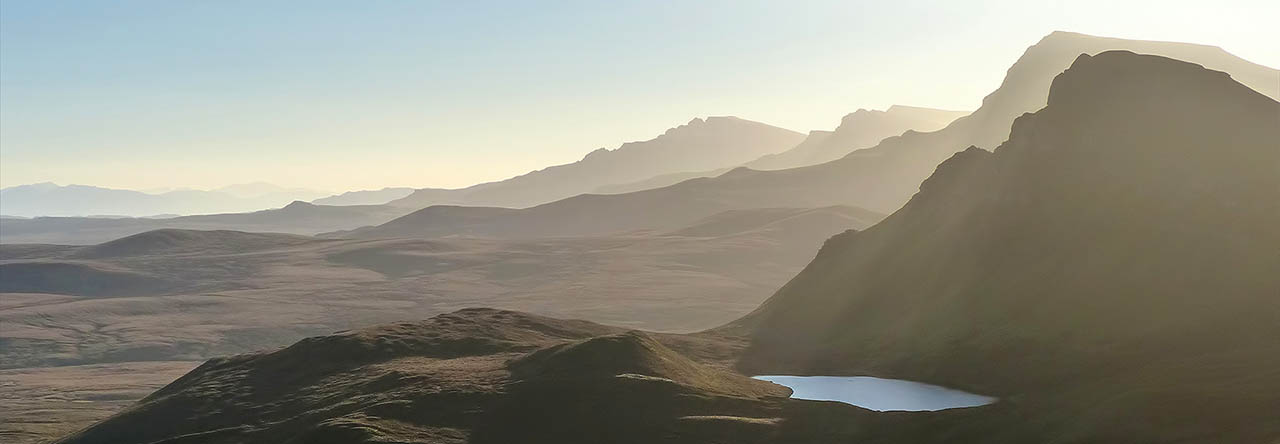
Sron Vourlinn25th August: yesterday, as we walked back from Rubha na h-Aiseig, the shapely peak of Sròn Vourlinn was prominent and dramatic on the skyline ahead. Today, we’ll walk to that peak and look back to Ferry Point…

There’s a fairly straight, level and most enjoyable route to Sròn Vourlinn from the top of the road from Staffin to Uig – unfortunately, everyone else agrees with me, as the first part of the walk is also the route to the much better-known Quiraing. We’ll try to avoid the crowds, and begin the walk on the path from Loch Langaig, down on the main road near Flodigarry (see also “Quiraing – the other way“). The path ascends steadily until it reaches a cairn marking a sharp right turn, in a hollow below black cliffs and startling pinnacles. There are other walkers around – one or two have used our path from Loch Langaig – but when we continue along the ridge to the north, we’ve got the hills to ourselves. The views are tremendous and extensive, from the mainland mountains to the east, through a far-reaching seascape to the hills of the Western Isles. In the middle distance, with Lewis on the horizon, is Rubha na h-Aiseig. To the south, down the Trotternish ridge, the landscape is a tangled confusion of crags, cliffs and pinnacles. Just don’t get too close to that vertical cliff edge!

View OS map on Streetmap http://www.streetmap.co.uk/map.srf?X=145733&Y=870841&A=Y&Z=120

Ferry Point

24th August: It’s Rubha na h-Aiseig on the map – and just a mile further north is Eilean Trodday. The island was inhabited once – was this where the ferry departed? There’s no road, and barely a path, but the route is fairly obvious. The descent from the rocky cliff-top to the shore follows what seems to be a made way – a well-graded route with a single zig (or zag?) close to its foot. There was no shortage of tourists on the single-track road round the north of Trotternish (16-registered hire cars, terrified expressions on their drivers’ faces… I’m guessing, of course) but on this short walk, we’re alone – apart from one solitary sheep, lots of gannets, and the crew of a passing yacht. After two days of motorways and busy roads, it’s perfect!

View OS map on Streetmap http://www.streetmap.co.uk/map.srf?X=143933&Y=875636&A=Y&Z=120

Lowland Leven

22nd August: later that day. There’s a Loch Leven in the highlands, which was probably better known before the Ballachulish bridge was built – motorists would become well acquainted with it, either by crossing on the ferry or driving around it (a lengthy, if scenic, detour). This Loch Leven is in the lowlands, by Kinross, former county town of Kinross-shire. We’re staying overnight, and before we eat, we need a leg-stretch…