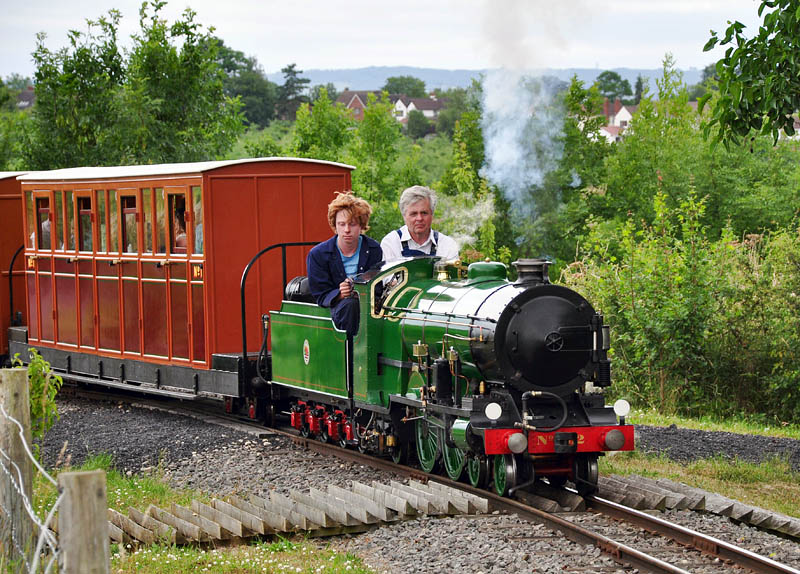
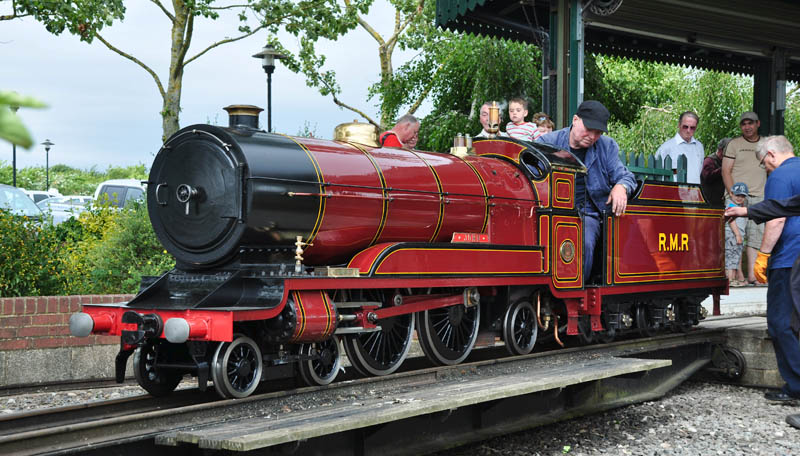
 The 15” gauge Evesham Vale Light Railway held a special “Weekend of Steam” event on the 3rd and 4th of July – we thought we’d better go and have a look. Stars of the show would be Welsh atlantics “Count Louis” of Fairbourne fame, and “John” from the Rhyl Miniature Railway. A “Rail Diaries” page is taking shape, in the meantime here are a couple of tasters.
Amerton
Just published to Geoff’s Rail Diaries, the full(ish) account of Sunday’s outing, plus 14 more photos. Visit “The Amerton Gala”

The Amerton Gala


A pleasant afternoon at Amerton – in the company of five 2’ gauge steam locomotives, contra-rotating on the circular(ish) line, between Stafford and Uttoxeter. Resident “Isabel” is back in action – along with vertical-boilered “Paddy”, Wrens “Jennie” and “Peter Pan”, and “Max”, the O&K 0-6-0 from Statfold. A super little railway – especially when the sun shines like it did today.
A “Rail Diaries” page will appear before too long…
Sunshine and steam at Statfold
 Just published to “Geoff’s Rail Diaries”, an illustrated account of Saturday’s open day at the Statfold Barn Railway. Ten locomotives in steam (and one more on compressed air), a 2’ gauge Land Rover (should that be Rail Rover?) and all the usual additional interest. Visit “Ten again at Statfold”.
Wightwick

 Wightwick Manor is a relatively modern house (National Trust) – but a good subject for the camera on this afternoon of bright sunshine and clear blue skies (between the clouds, that is). Hard to believe we’re less than 3 miles from the centre of Wolverhampton…
Warm weather on the Wenlock Edge

 At last! The car told me it was 82 degrees in the old money – about 27.5C – as we drove the short distance home. It had certainly been hot in the sunshine, though most of our walk was pleasantly cool amongst the trees. Still plenty of bluebells, and a fair smattering of early purple orchids. The air seemed too clear for settled warm weather though, and the forecast is for a cool down over the coming week
The other Manchester tramway
 Manchester had a tramway many years ago, long before Metrolink – sadly it closed as long ago as 1949. A tiny fragment remains, and is active, in Heaton Park, in Manchester’s northern suburbs. Visit “Heaton Park Tramway” on “Geoff’s Rail Diaries” for the usual illustrated account of this short visit (on a day when many of the northern steam railways seemed to be running trains with faces…)
Edward Sholto
Just published – the illustrated account of Saturday’s fun at Apedale. Visit “Edward Sholto” on Geoff’s Rail Diaries
MRT – IRS AGM…
 Translation – today, the Industrial Railway Society held its Annual General Meeting at Apedale, Staffs, home of the Moseley Railway Trust’s new narrow gauge railway. Such events provide an ideal excuse (should one be needed) to get out everything that works and give it a run. In the case of the MRT, the range encompassed by “everything” is truly eclectic – from recently-restored (last steamed in the 1950s)
 Hunslet “Edward Sholto”, to a Motor-Rail that looks, for all the world, like a garden shed on rails.
A “Rail Diaries” page will inevitably appear in due course, in the meantime, here’s a sample of sublime and ridiculous!
Spring at last
A sunny afternoon – a walk down to the river and back, and at last some real signs that spring is here.


Yes, the year’s first violet, and the year’s first butterfly (a comma)
 geoffspages.blog