Ben Tianavaig

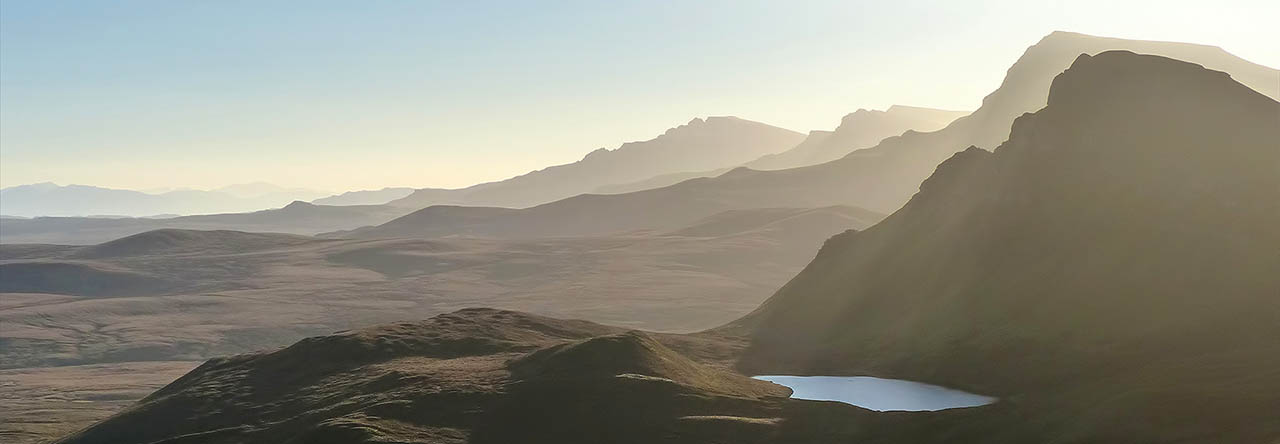
24 August: a walk to the summit of Ben Tianavaig, a prominent ridge with a small rocky summit overlooking Portree harbour. It’s no great height – 1352′ (413m) but is a superb viewpoint. The route follows the ridge to the summit and beyond, descending by the steep valley below to the shore. The path is clear enough, but needs care in places… An excellent outing – one of those unusual hills whose total descent seems to exceed the ascent…

The route is described here http://www.walkhighlands.co.uk/skye/bentianavaig.shtml; here’s a Google map

Evening light

Camus Mor and nearby:

Dunvegan and Kilmuir

22 August ctd: an afternoon walk at Dunvegan – it’s described as the “two churches” walk, from the old ruin on the hill, across the moor and back through the forest to the new(er) church opposite the shore. A short detour takes in the Millennium Monument, a standing stone erected by human effort. Afterward, we drove down the shore beyond the castle, where seals bask on the many islands in Loch Dunvegan.

The light in the evening was too good to ignore – just right for a walk along the road through Kilmuir.

Dunvegan Two Churches Walk – we did it anticlockwise, starting from the lay-by near the old church

The Cave of Gold

22 August: a beautiful bright, clear, sunny morning on Skye – perfect for a walk along airy clifftops with superb views to Lewis and Harris. It would be a good walk even if there wasn’t a cave of gold – the Uamh Oir – at the far end. The guide books say it’s inaccessible, as was the case today, but many years ago, at a low spring tide, we managed to get inside, to scramble along slippery rocks and retrieve the gold. So don’t bother trying…

A circular route would be perfectly possible, but further outings were planned for this fine day, and the most scenic route is to retrace one’s steps.

Canal Central

A stroll along the bank of the Montgomery canal, a formerly dry section that has only relatively recently been restored. It’s connected to the national network at Frankton Junction, and is in water as far as Redwith Bridge, on the Knockin to Llynclys road. It’s navigable as far as Gronwen Wharf; the next stretch to Redwith Bridge is clearly appreciated by the numerous moorhens, ducks, swans and others. Beyond, work is in progress to extend the navigable waters, though it looks to be a slow job.

Canal Central is a good place to start the walk – it’s an even better place to end…

Starboard Way revisited

A short walk on the southern part of the Long Mynd, along the cutely-named Starboard Way past the gliding field. The paragliders (is that what they’re called?) are in the ascendancy (so to speak) these days – dozens of them wheeling above the steep western slope, and just two or three hang gliders. The conventional gliders were being winched up at regular intervals too. The large white butterfly behaved itself for a photo, but none of the many peacocks were cooperative, so no photos. Then, by the pool, we startled a dragonfly, which, when it landed again, got on with the business of laying its eggs (we think…).

Flying things notwithstanding, it was a good afternoon for a wander on the Shropshire hills – the air was clear, with views extending to Cadair Idris, some 45 miles distant on the western horizon.

Mawddach

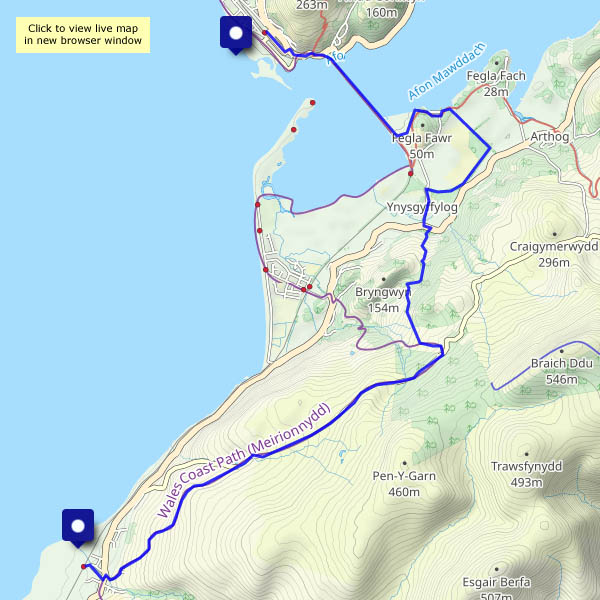
A walk from Llwyngwril to Barmouth

“Day return to Barmouth, please” – but we’ll leave the train, on the outward journey, at Llwyngwril, a request stop a little way down the coast. The one-year-old Wales Coastal Path takes us over hill lanes where a red kite quarters the ground. Standing stones and other antiquities suggest it’s an ancient route. We drop down to Morfa Mawddach, where a triangular railway junction once connected the Cambrian coast line to the long-gone line to Dolgellau and, ultimately, Llangollen and Ruabon. The Coastal Path descends to Fairbourne before skirting the estuary to the Bridge – but the path is closed where coastal defence work is ongoing, and my companion suggests a route that follows the disused railway for a little way inland, before cutting across the marshes (the path is dry) to the unlikely row of houses at Mawddach Terrace.

The long wooden trestle that is Barmouth Bridge carries the railway and, alongside, a footpath and cycleway with extensive views inland. Once over, all we need is a little refreshment before joining the train for the long but scenic journey home.

View OS map on Streetmap http://www.streetmap.co.uk/map?X=259905&Y=285170&A=Y&Z=126

Orchids on the Edge

A walk up the lane from the National Trust car park in Much Wenlock – to see if the orchids were out… They were – and they weren’t on their own. (I’ve no idea what the orange blobs are in the last photo – we thought they were some kind of tiny fungi, hardly bigger than match heads – but looking more closely at the photo, they seem to be growing on the moss itself)

On the Mynd again

Wall-to-wall warm sunshine – blue skies, clear air, a pleasant breeze – perfect! It’s been a long time coming. Ideal conditions for a walk from Little Stretton, up beside Small Batch to Pole Bank, back down the Ashes Hollow. A red kite circled, then descended into Callow Hollow; later he appeared again over the ridge, and we saw him one last time as we walked down the quiet valley (maybe three different kites? I doubt it). He didn’t stay – left it for us, the sheep and the buzzards. Other than the aforementioned, and lots of small birds, singing loudly, we had the Ashes Hollow to ourselves. For much of the descent, there’s nothing man-made in view (other than the path) – it can sometimes be hard to believe we’re in the English Midlands.

Wetmore and The Speller

A walk from Aston Munslow into quiet country on the Wenlock Edge. The Munslows are on the Corvedale road, which isn’t particularly quiet, but through Millichope Park and down into Hope Dale, there’s mostly just birdsong, plus a few sheep and a noisy dog at the farm. A rustle in the trees below gave us a glimpse of a deer, and a red kite wheeled for a few moments before disappearing behind the trees – neither were there long enough, or near enough, for a photo. The kites are coming further and further east from their mid-Wales stronghold – there was one over our house yesterday, a real “first”.

The Speller? Clearly labelled as such on the OS 1:50000 maps, and their 1″ predecessors, the name has intrigued me for many years. There’s a Speller Brook, which flows down through Millichope Park, and Speller Coppice is an area of woodland in these parts. Other than that, I’ve no idea what it is, or refers to.

There were still patches of snow here and there, where the deepest drifts would have been. Still quite a bit on Brown Clee too, though the air was so hazy we could barely see it. It’s still cold, too – very few signs of spring in the Shropshire hills

Snow in South Shropshire

It’s the 3rd of April today, yet the heavy snowfall of the weekend before last (eleven days ago!) is still very evident in the hill country. It’s blown and melted from the more open ground, but it’s deep amongst the heather and gorse, and some substantial drifts remain. The (very) minor road south from The Bog is blocked below The Rock.

It knocked us off our planned course too – very slightly. We were intending to arrive back at the Bog Centre in time for refreshments, and they would close at 5pm. Time was getting tight by the time we’d walked our way round to The Rock, and progress along the ridge (the preferred route) would have been slow and laborious given the depth of snow. So we walked along the road instead – much quicker, and we were able to say hello to the llamas along the way…