Sròn Vourlinn

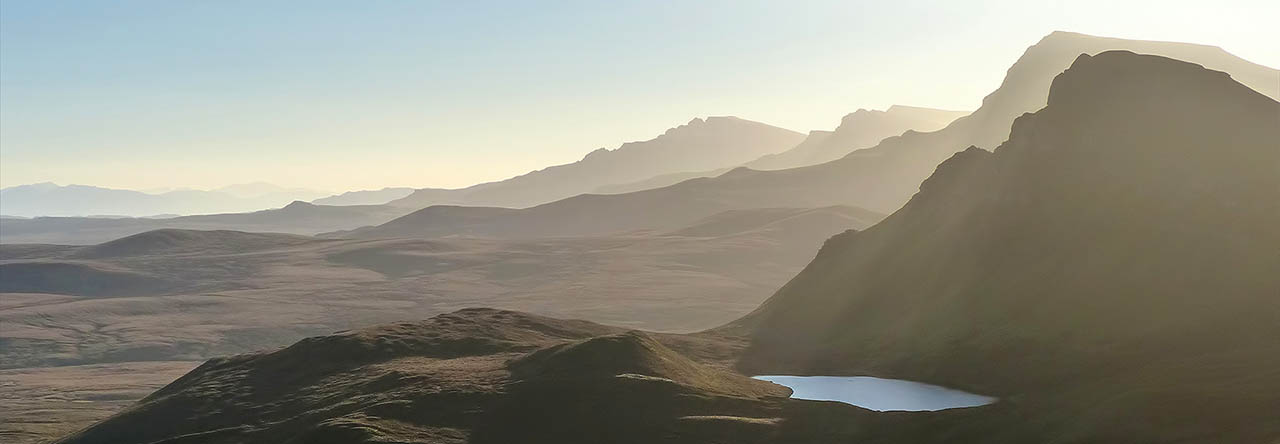
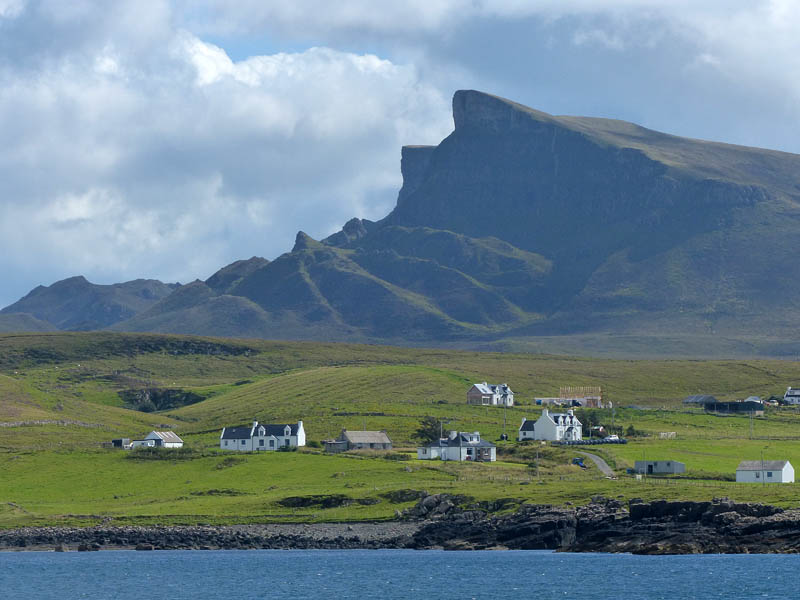
Sron Vourlinn25th August: yesterday, as we walked back from Rubha na h-Aiseig, the shapely peak of Sròn Vourlinn was prominent and dramatic on the skyline ahead. Today, we’ll walk to that peak and look back to Ferry Point…

There’s a fairly straight, level and most enjoyable route to Sròn Vourlinn from the top of the road from Staffin to Uig – unfortunately, everyone else agrees with me, as the first part of the walk is also the route to the much better-known Quiraing. We’ll try to avoid the crowds, and begin the walk on the path from Loch Langaig, down on the main road near Flodigarry (see also “Quiraing – the other way“). The path ascends steadily until it reaches a cairn marking a sharp right turn, in a hollow below black cliffs and startling pinnacles. There are other walkers around – one or two have used our path from Loch Langaig – but when we continue along the ridge to the north, we’ve got the hills to ourselves. The views are tremendous and extensive, from the mainland mountains to the east, through a far-reaching seascape to the hills of the Western Isles. In the middle distance, with Lewis on the horizon, is Rubha na h-Aiseig. To the south, down the Trotternish ridge, the landscape is a tangled confusion of crags, cliffs and pinnacles. Just don’t get too close to that vertical cliff edge!

View OS map on Streetmap http://www.streetmap.co.uk/map.srf?X=145733&Y=870841&A=Y&Z=120

Ferry Point

24th August: It’s Rubha na h-Aiseig on the map – and just a mile further north is Eilean Trodday. The island was inhabited once – was this where the ferry departed? There’s no road, and barely a path, but the route is fairly obvious. The descent from the rocky cliff-top to the shore follows what seems to be a made way – a well-graded route with a single zig (or zag?) close to its foot. There was no shortage of tourists on the single-track road round the north of Trotternish (16-registered hire cars, terrified expressions on their drivers’ faces… I’m guessing, of course) but on this short walk, we’re alone – apart from one solitary sheep, lots of gannets, and the crew of a passing yacht. After two days of motorways and busy roads, it’s perfect!

View OS map on Streetmap http://www.streetmap.co.uk/map.srf?X=143933&Y=875636&A=Y&Z=120

Glen Uig

Or is it Glen Conon? That’s the river; the OS map labels the north side as “Glen Conon”, as does the road sign for its road. The southern side? The sign points to Sheadar and Balnaknock, but it’s best know as the road to the Fairy Glen. We walked both roads (it’s very wet off-road at present), with the aim of following their continuations, as rough tracks, a little way up onto the moor. In both cases we were thwarted – by awkwardly-placed stepping stones on the south side, and a morass at the gate on the north side.

The Fairy Glen is, almost literally, crawling with tourists, struggling to top Castle Ewen. Away from the fairies, these are very quiet ways. There are fine views of three substantial waterfalls to the north (the first of which was a possible objective if we’d been able to cross the morass). Both roads leave Uig by steep hills, with wonderful zig-zags, and from the top there’s a fine prospect of Uig bay, and the ferry for the outer isles.

Sheader, Balnaknock and the Fairy Glen

Glen Conon

An Àird – dodging the showers

We drove through a heavy shower (it was supposed to be “mostly dry”) on the way there, had to don the waterproofs briefly while we were out on the headland, and drove into another heavy shower as we left. But between the showers, it was good to be out on An Àird, the wing-like peninsular at The Braes, looking across to Raasay. Last year I climbed Ben Tianavaig, the striking peak immediately to the north. I wouldn’t have wished to be there today…

Sìthean a’ Bhealaich Chumhaing

North of Portree there’s a ridge – a line of hills frequently seen in photographs but, I suspect, infrequently visited. The photographs in question are of the Old Man of Storr, with the Storr Lochs and the hills in question behind. The highest point, Sìthean a’ Bhealaich Chumhaing, is just 1286′ above sea level – but that sea is less than half-a-mile from the summit – it’s a splendid airy viewpoint which makes this scenic walk well worthwhile.

I’d be doing this one on my own (just as well…). The household authorities were going shopping in Portree – if I left my car at the north end of the Storr Lochs, I’d have a lift to the start. I’d rather have done the walk in the opposite direction, but that wasn’t going to be quite so easy to organise. Having done the walk, I realise it would be much better walked north to south – route-finding would have been easier (there are a couple of moderately tricky spots going south-north, where it’s important to find the right places to descend from lines of crags). It would have involved less ascent too!

I set out from Portree along the very pleasant path to the Black Rock, continuing by the curiously named “Bile” (a raised beach, apparently) to the start of the ridge proper. There is no obvious path over squelchy moorland which must be crossed before reaching the grassy sheep-cropped ridge, where no path is needed – it’s excellent walking. The main peak comes first, followed by two lesser tops, Creag Ulatota and Fiurnean. The last stretch back to the power station road is a long slog across a pathless sodden moor of tussocky grass, making for slow and hard going, and damp feet. Only once did I see a bootprint. Back at the car, there’s a sign – the Scottish Rights of Way and Access Society proclaims a footpath to Portree, 6.5 miles. Wishful thinking! If there was a path, it would be a truly excellent walk. And it may be 6.5 miles as the crow flies – but I reckon I walked nearer 8…